↓
 

Swami Sri Atmananda

Founder, Satyachetana International Spiritual Movement

Swami Sri Atmananda 
 
  • About
  • Contact
  • Links
  • Offerings

Post navigation

← Older posts
Newer posts →

Gita Verse 555: Applying Knowledge to Life

Swami Sri Atmananda Posted on April 2, 2023 by SevaApril 2, 2023

Omm Namo Bhagavate Vasudevaya

Message board one morning at Satyachetana Ashram

nirmaana-mohaa jita-sanga-doshaa निर्मानमोहा जितसङ्गदोषा

adhyaatma-nityaa vini-vritta-kaamaah अध्यात्मनित्या विनिवृत्तकामा:

dwandwair vimuktaah sukha-duhkha samgyair द्वन्द्वैर्विमुक्ता: सुखदु:खसंज्ञै

gachant-ya-moodhaah padam avyayam tat. र्गच्छन्त्यमूढा: पदमव्ययं तत्   

This verse comes in the fifteenth chapter, “The Yoga of the Supreme Being.”  Sadhana comes to an end when we reach the fifteenth step of the journey.  What is left is perfect manifestation.  In this chapter the Lord explains what should be the state of one who is fit to be a channel of the manifestation of the Supreme Truth.  Being and becoming are manifested fully at this stage.  Being is pure awareness, becoming is total experience.  At this stage, the yogi is established in experiential awareness and awarenessional experience

In the past I have explained the sequence of the descent, how a completely liberated being reenters the world of maya.  We began with the eighteenth chapter.  The liberated being reentering into the world of delusion is a conscious descent, like the Siva consciously descending to prakriti in order to manifest prakriti’s will.  Purusha has no will at all.  Prakriti has the will.  Prakriti wants perfect manifestation of the purusha.  The purusha must be able to retain its total awareness even while experiencing all that prakriti creates.  This is the object of prakriti.  The ultimate goal is: retaining the total awareness of the Being, the yogi must be able to function perfectly in the world of becoming.  But the universal experience is that as you go towards samadhi, the state of the Being, you develop a dispassion, repulsion, neutrality, and indifference towards experience.  That is not what Gita wants us to attain.

Prakriti here is synonymous with the purushottama.  In the seventh chapter the Lord explained the two prakritis: ‘I have one lower prakriti that is made up of the five elements and mano, buddhi and ahankära, that is mind, intellect and ego.  Then there is my higher prakriti, the jiva.’  But in the fifteenth chapter he says, ‘I am higher than the lower, and beyond the higher.  That’s the state.  That is I, the Supreme Being.’  In Verse 561, Gita says striving yogis can attain that stage.

For the yogi who has begun the journey, there are different junction points where he can review, reevaluate and look within to find out whether he is proceeding in the correct path.  At the end of the fifth chapter such an opportunity came to the yogi for the first time:

bhoktaaram   yagna-tapasaam  sarva-loka   maheshwaram

suhridam   sarva-bhootaanaam  gyaatwaa-maam   shaantim-richhati

“Knowing Me in reality as the goal of all sacrifices and austerities, the Lord of all the worlds and the Friend of all beings; one attains supreme peace.”

You should reach a state after perfect sannyasa whereby you the yogi, that is, the being, is enjoying, bhoktaaram, the fruits of all action that only come out of yagna, that is sacrifice, and tapasya, that is austerity.  That is the acid test of sannyasa.  Any result that comes from actions that are not considered yagna or tapasya should not be eaten.  That is the prohibited fruit.

Gita summarizes the whole concept of yagna into five types:

190: Some perform sacrifice with material possessions, some offer austerity as sacrifice, others follow any path of yoga as sacrifice, while some earnest seekers perform sacrifice in the form of wisdom through the study of scriptures.

A yogi who aims at the highest state of Gita yoga should not accept the reward of actions that are not from yagna or tapasya, even if they come without asking.  This is the reason I have put a restriction on what is given to me.  If you want to give, you give to the ashram, you give to a temple, but to give to Swamiji you have to qualify.  I am aware that the moment I allow anything to be accepted, I am likely to be contaminated by the karma of that action, because karmas are not performed in a spirit of yagna, nor in conformity with the triple austerity: verbal, mental and physical austerity.

A yogi gets contaminated even after attaining the state of the Being because the body receives the result of these actions that are performed without the spirit of sacrifice or austerity.  When the body is contaminated, the mind will be contaminated next, then the vital.  When the vital is contaminated it is manifested through our words and reaction pattern.  This is the reason the Lord said in his parting advice that even after attaining enlightenment, one is not supposed to give up sacrifice, charity and austerity because these purify even the liberated beings.

In Kali Yuga that contamination happens all the time, so after attaining true sannyasa the yogi should always ensure that he is not accepting the result of actions that are not sacrifice or austerity.  If this is ensured then the there is no chance of contamination.

Food is the first thing that contaminates your system, especially boiled food.  If you are taking food from someone whose consciousness is not pure, your system will be completely devastated.  Food nourishes your body but contaminates your consciousness if it is not coming from a pure source.  It must be prepared and offered in a spirit of yagna.

There was one great sannyasi siddha here who was always sitting, looking at Arunachala.  The moment you would go near him, he would change his posture so he was not looking at you.  People felt he was a mad sadhu, and they dropped coins and such near his place, thinking that he would take the money when they went away.  But when the time came for him to go, he would get up and leave all those coins and money that were thrown there.  Why?  Because money that is earned by man is fully contaminated by karma.  Who knows how many tons of desire, greed, lust, jealousy and hatred is in that money.  That is why money in Kali Yuga is called the maya shakti of the Lord.  If you can find a wealthy man who is truly detached from his wealth, you are seeing a replica of God on Earth in a human frame.

This is the first test for the yogi who is really aiming at the highest state – ensuring that whatever he accepts has come to him through yagna and tapasya.  A second test came at the end of the ninth chapter, another at the end of the eleventh chapter, and another at the end of the twelfth chapter.  These are the stages when the yogi can verify whether he fulfills these criteria.

Verse 555 gives more conditions.  If you fulfill them, be a hundred percent sure you are ready to manifest Divine in mind, life and body.  What are these conditions?

First is nirmaana-mohaa.  Maana is I-ness, mohaa is attachment.  One who is free from maana and mohaa is called nirmaana-mohaa, free from ego and attachment.  The yogi in Chapter 15 has already gone through merger in the twelfth chapter and is entering manifestation.  God-realization is a stage when the spark has merged with the source, but whether one has transcended prakriti’s triple veil or not will be tested now.  When he comes out of the hiranyagharba and lives in samsara, in the material plane, he will face this examination.  Just for functional necessity he has to use the words of a common man, but if he is not retaining his awareness, the veil will come to him unconsciously.

I was with Maharishiji eighteen hours a day continuously for more than three years.  I was amazed at how a person did not utter the word “I,” even in the gravest provocation.  That is a mighty achievement.  A similar state was attained by Papaji Swami Ramdas and by Bhagavan Ramana.  Bhagavan Ramana was a pure gyaani and did not participate in any of the activities on the outer plane, but Maharishiji was involved in action twenty-four hours a day, fully detached.  You could feel and see that.  No wonder he became the channel of manifestation.

The yogi’s system should be free from the triple coating of sattwa, rajas and tamas, and not just when he is sitting and speaking on God.  If he is still not getting contaminated with maana and mohaa when he is working with deluded human beings we can say he is a nirmaana-mohaa.

The next condition is jita-sanga-doshaa, one who has conquered the evils of companionship.  You cannot interpret this companionship from an ethical or moral angle.  Sanga-doshaa here refers to the evil that every action contains.  Every action carries with it the seed of future action and also the fruit of the action.  These are the two sanga-doshaas: the seed and the reward.  If you are identified with the result, if you are doing anything with a result motive, or if you are claiming the benefit of the result, you are not free from sanga-doshaa.   First perform action and when the result comes, renounce it.  Then you come to the next stage when you renounce the result before performing the action.  Because we are at the end of sadhana, I am not talking of the gross result.  I am talking of the identification that comes in the consciousness.  Everything in this prakriti plane is action.  From action comes reaction, and from reaction comes more action.  But if you have mastered the technique of karma yoga, you don’t perform action; you remain completely in a state of inaction.  You are simply responding to prakriti’s signal.  That is the secret to transcend prakriti.

Because we have to work in the material plane, in the world of maya, if we do not retain that awareness prakriti will trap us.  When the yogi transcends prakriti, prakriti cannot find any rope to trap him.  That’s the secret.

The fourth condition is adhyaatma-nityaa, always remaining in continuous proximity to the being, the atma, your core consciousness.  This is the reason when I descend I say, “Thus far and no farther.”  You should not be so involved in the world of maya that you will be far away from your center.  You may be playing with your children, talking to your wife, chit-chatting with your friends, saying, “Yes, Sir” to your boss, counting money, flying in an airplane, or walking through mud, but let your consciousness be very near to your awareness.  If you can ensure that, you will reach the state of satchitananda, Supreme Being.

Next is vini-vritta-kaamaah.  Here kaamaah means desire.  The forces of desire will be activated when you participate in the world of maya.  For the sake of manifestation you have to work, but you must be completely nivritta, completely free from desire-yielding forces.  Don’t expose your system unnecessarily to rajas and tamas because they will enter your system, and if you are not doing sadhana every day, if you are not doing meditation or pranayam or swadhyaya, there is no way this coating can be erased.  Yagna-daana tapah-karma paava-naani manee-shinaam—sacrifice, charity and austerity—if you are doing these regularly every day, nothing can remain within.  Otherwise the system gets contaminated and the forces of desire enter into you.

How can you ensure that your system is completely free from the forces of desire?  If you always remain in a state of adhyaatma.  You can remain in that state if you have conquered the evils of companionship.  You can do that if you are nirmaana-mohaa.

When these conditions are fulfilled, the next one is bound to come, that is dwandwair vimuktaah, you are liberated from the dilemma between happiness and sorrow.  When you transcend that, you will not hesitate to perform a disagreeable action and you will have no pull for an agreeable action.  That is the gunatita state.

Such a person attains the imperishable, absolute state, where neither the sun nor the moon ever shine, nor does the wind blow.  The Lord says, yad-gatwaa na nivarttante tad-dhaama paramam mama, that is my dhaama, my abode, that eternal state of tranquility.  That is where the devotees will go who have transcended the Vishnu maya, the triple maya.

This is how the dissection of the scripture should be very deep, so deep that one can feel it.  And how can you feel it if you are not receiving from someone who is fulfilled?  He is so full in feeling, that he can make others feel it.  That is fulfillment.  When the pot is full it overflows.  This is the reason scriptures are to be learned from tattwadarshis, enlightened beings, because you receive the transmission of their realization.  This transmission will take the veil from within, that is, the layers of sanskaras and karmas and desires that you are not able to reach.

In gyaana you are able to understand every meaning, every mantra, every symbol.  When gyaana is applied to life through karma it will produce bhakti.  When bhakti is applied through karma it will bring gyaana.  That is why great bhaktas are great gyaanis and great gyaanis are great bhaktas.  The secret is application.  If you don’t apply it, nothing will come.

[From a 2009 Interaction at Satyachetana Ashram, Tiruvannamalai, India]

Posted in Experiential Guidance | Tagged experiential awareness, gyana, jnana, manifest

Audio: Spiritual Learning

Swami Sri Atmananda Posted on March 10, 2023 by SevaMarch 10, 2023

Omm Namo Bhagavate

The Satyachetana logo that a devotee draws with powder every morning on her home altar.

From a  2012 Interaction at Satyachetana Ashram, Tiruvannamalai, India. 17 minutes. 

Posted in Audio, Experiential Guidance

Feel the Maha Yajna

Swami Sri Atmananda Posted on February 24, 2023 by vishnudashJuly 26, 2024

Omm Namo Bhagavate

Satyachetana International is posting Maha Yajna videos and photos with links at this page.

Posted in Audio, Veda Yajna, Video | Tagged yajna

Join in the Maha Yajna

Swami Sri Atmananda Posted on February 20, 2023 by SevaJuly 26, 2024

Omm Namo Bhagavate

Anyone in the world can participate in the Maha Yajna as follows:

1. On any one day of the Yajna, light a lamp or candle for any one of the 55 Devatas on the following list, during the hours of the yajna havana (fire oblations) in India. The lamp or candle should burn for a minimum of 60 minutes.

2. When doing so, offer a prayer—not for yourself but for the entire earth and all of humanity

3. Send your name, location, and the Devata for which you lit the lamp, via the Contact page.

4. On the final day of the Yajna, a lamp for each global participant will be lit in one of the kundas so that each individual will also receive the benefit. 

Yajna timing: light the lamp or candle during any of the following periods. These are listed in India Standard Time, so covert that to your local time zone, and light the lamp accordingly. For example, 9 am in India is 7:30 pm Pacific time, so that is one of the periods when someone in San Francisco would light the lamp.

  • 22 Feb: 3 pm to 5 pm
  • 23, 24, 25 Feb: 8:30 am to 1:30 pm and 3 pm to 5 pm
  • 26 Feb: 8:30 am to 1:30 pm, and 3:00 pm to 5:00 pm 

Choose one Devata from the following list (Samaveda Samhita):

Aap
Aditi
Aditya
Aditya Gana
Agni
Agni or Havimshi
Agni Pavaman
Angira
Annam
Apanpat
Aparisukta
Apva
Ashwini Kumar
Ashwino Mitravaruno
Atma or Agni
Brahanspati
Bruhaspati
Dhavapruthvi
Gau
Indra
Indra or Marud Gana
Indragni
Indratrailok-yatma
Indravayu
Ishava
Lingokta
Marutagana
Mitravaruna
Pavaman Soma
Pavamana-dyetya
Prajapati
Purusha
Pusha
Ratri
Sadaspati
Samgramshisa
Saraswan
Saraswati
Savita
Soma
Surya
Surya or Atma
Tarya or Surya 
Tvashta, Parjanya, Brahanspati, Aditi
Usha
Vajina
Van
Varma Soma Varuna
Varuna
Vayu
Vishnu
Vishnu or Devagan
Vishwadeva
Vishwakarma
Yupa

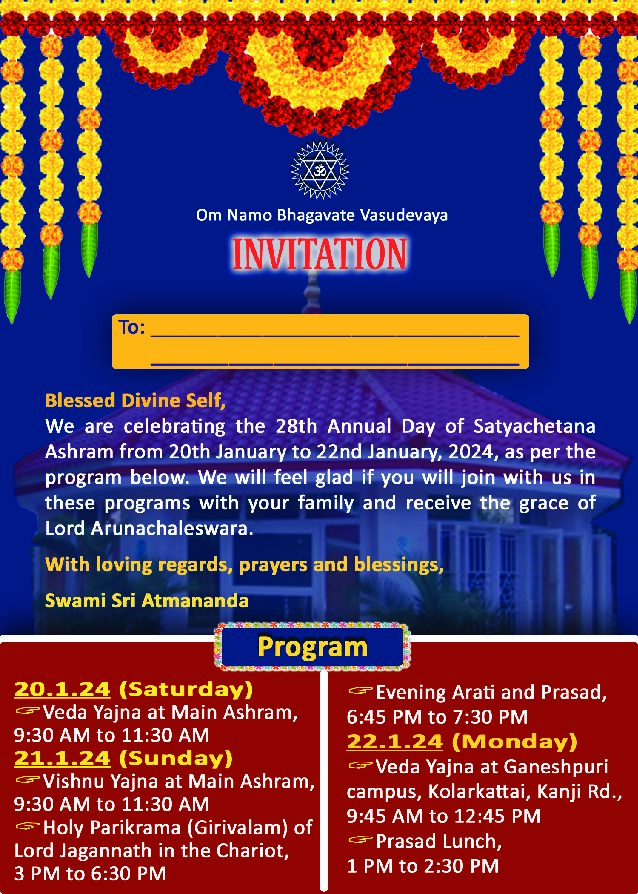
For more details on the Yajna, see the invitation posted here.

Posted in Experiential Guidance, Message Board, Veda Yajna

Invitation to Samaveda Maha Yajna

Swami Sri Atmananda Posted on February 20, 2023 by SevaJuly 26, 2024

Powered By EmbedPress

Posted in Message Board, Veda Yajna | Tagged yajna

The Benefit of Chanting

Swami Sri Atmananda Posted on February 13, 2023 by SevaFebruary 13, 2023

Omm Namo Bhagavate

Visiting a school in Hyderabad, where the students chanted by heart
Chapter 15 of the Bhagavad Gita

Chanting is the quickest, easiest and most powerful way of yoga.  What takes several years to achieve through normal meditation can be achieved within a couple of months through chanting.  That is why, in the Vedic period, sadhana was simply remaining in the house of the guru and only practicing swadhyaya.  Chanting is called swadhyaya.  When you do swadhyaya, who listens to it?  The soul listens.  You are chanting for yourself, for the Self.

If you are deep asleep in your room and I go and stand in front of your door and call your name, you respond when your mind receives it.  Mind responds to meaning.  If that word has no meaning, you will not respond, so even if you hear something you will not respond.  Vital responds to feeling and body responds to pressure or force.

The psychic responds to vibration, and the soul responds to rhythm.  That is called mantra.  When a mantra is chanted it has a rhythm, or chanda.  Now we are chanting the Veda each morning.  First sukta of the Veda is Gayatri chanda.  There are different types of Gayatri.  This one is called Tripada Gayatri, meaning “three steps”: first it will smash our gross thoughts of the physical world; second step, it overpowers all our vital relationships; third step it will smash our ego, so that the soul comes out.  So when you are chanting Gayatri continuously with proper rhythm, the attachment and the clinging and the ego are smashed.  What comes out is the soul.  That is why swadhyaya of the scriptures is performed, and the mother of all scripture is Veda.  Veda was there before god was there, because sabda is brahma, sound is brahma.  God is a discovery of human mind.  Veda pervades the whole creation, so Veda is the mother of all scriptures.  When you chant Veda you invoke the Mother force, and Gayatri is the mother of all chandas. Krishna, the supreme Lord also says this in Verse 407 of Gita: gäyatrï   chhandasämaham, ‘Among the chandas I am Gayatri.’

When you are chanting the Veda, you are invoking the supreme mother, the all-pervading prakriti, which vibrates the rhythm.  How far your force will go depends on how deep is your breath; how deep your breath goes depends on how many mantras you are able to chant without releasing your breath.  The longer is your prana, the greater is your control over your mind.  The deeper is your prana, the greater is your command over your vital.

In ashrams, there is no material activity, that is, any activity that is undertaken to expand matter for self-gain.  Any activity that is undertaken, not to expand matter for self-gain but to expand matter for manifestation of spirit, is not material activity.  What makes it yoga and what makes it bhoga, or enjoyment, is the attitude with which an action is performed.  If you do yoga, you are heading towards liberation; if you do bhoga you are heading towards disease, sickness, sorrow.  Bhoga brings roga, or diseases.  Yoga brings mukti, liberation.  Any action that is done for the purpose of manifestation or liberation is called yoga.  Any action that is done for self-gain is called bhoga, that is, samsara.

When you chant, your breathing is expanded and the prana is expanded.  A person who is only leading a very ordinary life, who has a human body but is actually an animal, the nature of his breath is very frequent and very short.  When you start doing yoga, your breath goes deeper.  To what extent you will breathe, whether to the first, second, third, fourth or fifth chakra, only the guru can tell you because the guru can see your system fully.  The guidance differs from person to person and each has the potential to grow from it.  First they overcome greed, then lust, fear and anger, because their sadhana is proceeding under the watchful eye of a seer who is guiding those individuals as per their system’s limitation.  But a child cannot do it, nor can one who is not leading a yogic life.

When you practice chanting like this your breath becomes deeper, and the deeper the prana goes, the more the apana comes out.  The seat of apana is at the muladhara, the first chakra.  Apana wants to come out, but it cannot come without prana going down.  When you hold the breath the apana joins with prana.  Apana brings out all the toxins from the body, from every cell.  Impurities are released through urine and stool, but the impurities of negative vibrations, negative thoughts and negative samskaras are stored up in every cell.  Only apana can bring them out, but apana cannot release it.  When apana joins with prana some of these toxins are released by prana.  Then when prana is released it is gone.  This is the secret: Pränäpäna  samäyuktah   pachämyannam  chaturvidham.  (Verse 564).

Someone came from another ashram a few years back.  He remained here for some time.  After eight or ten days he said, “Swamiji, I am feeling terrible difficulty for sadhana here.  My sadhana is not proceeding.”

I said, “I know that.”

“Swamiji, you know that?  Horrible thoughts are coming.”

I said, “Yes, I also know that.”

“Swamiji, what am I going to do?”

I said, “You have to go out of this ashram.  That’s the best thing for you.”

“I am staying in an ashram for twenty years, doing that yoga, but I have not attained what your people have attained here.  Why?”

I said, “Because you are doing yoga by reading a book.  They are doing yoga by following a master.”

His problem was, the moment he closed his eyes all his lustful thoughts were coming up; all lustful dreams were coming in the night.

“Why?”  He asked me.

I said, “Because you are living among celibates, you are living with brahmacharis, so the force they release is bringing up your hidden samskara.  There is no householder here, no lover nor beloved.  Brahmacharis radiate one type of energy that brings out the hidden energy.  Are you having that problem?”

“Yes, Swamiji.  What am I going to do?  Shall I meditate more?”

I said, “You cannot meditate.  Meditation requires that when you close your eyes, very quickly you should reach a thoughtless zone.  But you cannot go to the thoughtless zone because your breathing is short.”

Thought comes from the mind, and mind is the child of prana, so first control your prana, and the quickest sadhana for this is to chant the mantras.  When you are chanting, Dharmakshetre  kurukshetre samavetä yuyutsavah, you cannot release your breath.  You have to hold your breath to chant so if you are chanting four lines at a time, the breath is held.  See how easy is yoga.

Dharmakshetre kurukshetre samavetä  yuyutsavah, drishtwätu pändavänïkam, you continue.  First break it to small, small pieces.  When you don’t chant, your breathing goes its own way, and its own way is the monkey’s way, but when you chant, even if it is for half an hour, that half hour means pranayam.   Ayam means regulation, control; prana means life force.

In this chanting, now you are doing the third, fourth and fifth line in one breath, but no one is able to go to the sixth line.  When you are able to do that, your prana is going right to your manipuraka.  Then it goes deeper.  The longer the breath, the deeper is the force.

When you practice like this, and then you just sit, thought cannot come until you want it to.  If I sit hours and hours and hours thought will not come unless I invite it.  Awareness of a person will come, but thought of the person will not.  Awareness means no thought but you are conscious of the presence.

We are having awareness of God but no thought of God.  When thought of God will come, your life is divine.  When God will be in your thought, you achieved a great thing.  Mayyeva manädhatsva, God is in your thought, God is in your feeling, God is in your awareness.  Life is becoming divine.

[From a 2010 Interaction at Satyachetana Ashram, Tiruvannamalai]

Posted in Experiential Guidance | Tagged sadhana

Audio: “The mighty-armed Arjuna.” (Gita Verse 56)

Swami Sri Atmananda Posted on January 26, 2023 by SevaMay 14, 2023

Omm Namo Bhagavate

Swamiji sharing with parents of students at the Universal Veda Gurukulam

From a February 2012 Interaction on Gita Verse 56, at Satyachetana Ashram, Tiruvannamalai, India.

Posted in Audio, Experiential Guidance | Tagged Gita Yoga

2023 New Year Message

Swami Sri Atmananda Posted on January 1, 2023 by SevaJanuary 1, 2023

Omm Namo Bhagavate

Swamiji’s New Year Message on 1 January 2023, via Zoom from Satyachetana Ashram in Tiruvannamalai, India.

Posted in Message Board, Video

Post navigation

← Older posts
Newer posts →

Newest Posts

  • You Have Forgotten Your Own Nature July 18, 2026
  • Sense Control is Not Yoga July 11, 2026
  • The First Phase of Yoga is Link July 4, 2026

Archive of Posts

Subscribe for Updates

BE SURE TO REPLY to the confirmation email—check your junk mail folder in case it goes there.
Loading
©2026 - Swami Sri Atmananda
↑
error: Content is protected
-