Omm Namo Bhagavate
Prakriti is said to be responsible for cause and effect and the sense of doership, while purusha is said to be the cause of the experience of pain and pleasure.
Srimad Bhagavad Gita, Verse 509
This verse can be interpreted as discussing action and the cause of action, or action and the different means or instruments that are needed for performing it. The source of both action and its cause is prakriti, or nature. Purusha, the soul, has nothing to do with action, nor with the factors responsible for the success or failure of the action. However, purusha is responsible for the experience of happiness and sorrow, because purusha experiences the result of action.
Since purusha is the enjoyer of the result, or the fruits of action, purusha experiences sorrow or happiness, success or failure, fame or defamation, and gain or loss. Prakriti does not experience any of these, because prakriti herself is the experience. Purusha is the experiencer. The title of this chapter means, the difference between prakriti and purusha, or the difference between the field and the knower of the field.
Anything that happens in the material plane is governed by the law of nature—the law of prakriti. Prakriti, not purusha, decides what will be the nature of the action, and prakriti’s responsibility is to ensure that the action is successful. Thus, prakriti will arrange all the factors that are necessary for the accomplishment of the action. Purusha is always a non-doer; purusha’s action begins only when prakriti’s action ends.
Prakriti’s role is to activate the process of action and then to ensure that the result comes. When this process is completed, purusha experiences the result and pronounces the judgment as to whether it is good or bad. Pronouncing this judgment is not necessarily a problem. The purusha gets clouded only when it gets identified with the process of prakriti. If purusha is not getting identified with the result—that is, what the purusha is experiencing—and is not identified with the process of how prakriti is doing it, then purusha can maintain his state of equanimity.
As a result of the action, purusha goes through happiness and sorrow. These come when the purusha attributes some qualification to this experience: “I should experience it more; I should experience it less; I should not experience it at all.” When any qualification is added to the experience, it no longer remains as experience—it becomes enjoyment and the purusha becomes contaminated. That is, the awareness gets contaminated with experience, and instead of only experiencing the result, the purusha also experiences sorrow and happiness. The root of all clouding, veiling, and contamination comes when the purusha begins to enjoy rather than experiencing. As a result, purusha falls one step further below. This is revealed in Verse 510.
Prakriti is the agency. She decides what will be the action and the nature of the result. This is done for purusha because purusha, the pure awareness, the being, wanted to experience the becoming. The being is awareness; the becoming is experience. The awareness wanted to experience the manifest part. The unmanifest purusha wanted to experience its manifest attributes. That is how the whole process starts. While experiencing it, the purusha gets identified with the attributes, and the veiling mechanism begins.
Experience itself is not bad. Getting identified with the experience is the root of all problems. Gita does not say, ‘Don’t experience.’ Gita says, ‘Experience but don’t get identified with the experience, and don’t qualify or quantify it.’ If you do, you will become stuck up with the triple veil of sattwa, rajas and tamas. You will be trapped; you, the awareness, will lose your awareness and be identified with experience. The coating will begin, and a time will come when you will be experience only, without awareness. The way out was shown to the yogi long back in the fourth chapter, when the Lord said in Verse 214, ‘Keeping your consciousness fixed on the Absolute, if you are only responding and experiencing, not enjoying, then your awareness will not be contaminated. You will float like the lotus leaf floats on water.’
Prakriti is always eager to activate the desire process within the purusha and ensure that the purusha gets trapped by his desire. All the signals to purusha come from prakriti. The moment purusha shows a special interest, prakriti is ready to fulfill it, and grant the desire. That is how prakriti wins. The whole process of yoga is nothing but understanding this play. Prakriti loves to veil the purusha; purusha loves to maintain his awareness. If purusha remains in pure awareness, prakriti is miserable because she feels she has no purpose, so prakriti will want the purusha to be fully veiled. Whereas purusha struggles to maintain its awareness so that prakriti will be under control. Once purusha gets identified, prakriti traps the purusha and awareness gets clouded. This clouding, veiling and contamination with the attributes of prakriti is the cause of purusha repeatedly taking birth in good or evil wombs.
The secret of how purusha can maintain its neutrality even while ensuring total involvement in prakriti’s play is revealed in Verse 511. The origin appears in 509 and the process of veiling is explained in 510. The solution comes in 511, which says the purusha should always remain a perfect witness: remaining very near but retaining the state of witnessing. This witnessing state is possible when there is a distance between the subject and the object, that is, a gap between the senses and the object of senses. Purusha is witnessing, while prakriti is watching purusha, because it is just a matter of time before purusha will be completely caught in her web. Prakriti watches how purusha enters into the trap.
Gita says purusha should develop the strength to witness prakriti’s play while remaining very near. In yoga, when somebody is heading towards Self-realization, the first attainment that comes is the witnessing state. The second is giving consent. As prakriti is preparing the rope to bind the purusha, purusha is remaining very near and watching—neither interfering, nor asking why prakriti is doing this. Purusha simply gives consent without opposing in any way: “Yes, prakriti, what you are doing is fine. Do it.”
The third quality is to support prakriti. Suppose prakriti is not capable, and needs help to prepare the rope. Now she will look at the purusha and the purusha should give her the strength. Here, purusha is the sustainer. When the purusha is able to complete these three stages, prakriti will complete her work. She does it all for purusha, and offers everything to the purusha only. If there is no purusha then prakriti has no purpose: “Without him I exist not…” Wherever there is prakriti there must be the purusha.
Prakriti means action, and action must have a purpose and a cause. Prakriti’s only purpose is to offer it to purusha. That is why every action in the ultimate stage is nothing but an offering at the feet of the Lord. The more one proceeds towards perfection in yoga, the less he feels the prompting to do anything. A time comes when he becomes the perfect non-doer. He just lives like a statue because the prakriti within is completely swallowed up by the purusha; that is, the experiential urge is completely swallowed by awarenessional height. The more you reach awareness, the less you will feel the need to perform any action. The reason these saints and great souls don’t perform material action is not because they are lazy, but because the urge is not there. The prakriti within is completely encircled by the awareness.
Prakriti’s purpose is to prepare it, perfect it and then offer it. Until it is offered, prakriti is not at peace. Once it is offered, the purusha is supposed to experience it, so you cannot refuse anything that is coming to you from prakriti. You should respond, because whether it is happiness or sorrow, profit or loss, fame or defamation, good or bad, pleasure or pain, it came to you because you wanted it. Everyone is responsible for what he gets. There is no third person. Find out from within why something is happening to you. Instead of finding the cause outside, the seed must be located inside. That is the highest state of jñana. If you have transcended maya, you will be able to clearly see that the signal is not directed towards you, it is directed to someone else and prakriti just wants to use you as a postman to deliver the news.
From witness to consent-giver to sustainer or giver of strength. Next is accepting it. In the second chapter the Lord says to endure these experiences in a state of perfect calmness, because through that prakriti is pushing you beyond everything. Only a jñani can see that. If you pass through these four stages and you are still able to retain your awareness, then instead of being the slave to your prakriti, you become the Lord of your prakriti. Ultimately you reach the state of the Supreme Being: capable of retaining the state of pure awareness even while experiencing everything. When you become the Lord of prakriti, in traditional yoga you are called a Swamiji. That means you are capable to witness, give consent, support and go through all experience, without losing your awareness. A perfect Self-realized being is called a Swami. As a mark of respect the suffix -ji is added to make it Swamiji.
The first part was sadhana for realization; the next part will be the struggle for manifestation. When the yogi is able to withstand the holocaust of the outer prakriti then he becomes the Supreme Being. Gita’s sadhana is these steps: witness, consent-giver, sustainer, enjoyer, and then the Lord of the individual prakriti. Last is the Supreme Being. This purusha, this embodied being, should pass through all these stages while remaining in this body. Gita does not accept that sadhana is finished after attaining Self-realization. All five of these stages must be completed. Then only will the purusha will become the supreme purusha, the Supreme Being.
The first challenge is reaching the witnessing stage. Remaining very near to the object of enjoyment but not jumping into it is possible only if the yogi has perfect control of the senses and the mind. That is why practice is necessary. If the senses are completely disciplined, they will not run towards the object because the mind will keep them under control. Mind will be under control if it is under the command of the intellect, or buddhi. Intellect will be stable only if it is linked with the being. When the intellect is linked with the being, and becomes constantly stable like the being, that is called equanimity. Whatever may be the outer turmoil or outer attraction, one is able to retain the awareness that, “No, I am not supposed to descend beyond this limit.” When a yogi knows how much to descend and where and when to stop, it means some level of the equanimity state has been attained. Otherwise it is not possible. Without attaining equanimity the yogi will completely fall.
The yogi should always focus on reaching the state of the Supreme Being in this life, before dropping the body. This should be the goal, not liberation, nor Self-realization. The yogi must be mentally prepared that to reach the state of the Supreme Being, he has to go through these five stages.
The witnessing state will come if there is constant sense control. Sense control will come only if you are remembering your goal. If you do that you will be able to discriminate how much to experience and when to stop this experience. This is how the senses will be brought into moderation, mind will be linked with the intellect, and the intellect will guide you. Mind does not give you clear-cut direction. It is like a monkey. Don’t rely on the mind; rely on your intellect’s sense of reasoning. Intellect will guide you correctly if it is linked with the being. If intellect is linked with the becoming, that is, the outer world, then you can never receive inner guidance.
The yogi must focus on the goal. The witnessing stage must give way to the state of consent-giver. Then the supporter gives strength to prakriti. Remember always, prakriti has only one role: to veil you, trap you and contaminate you. However, prakriti needs support because purusha is the strength of prakriti. Without purusha, prakriti is crippled, so you give the strength to enable prakriti to accomplish her task. Then prakriti will offer it. Offering is not an action; it is a transmission. If you are offering to me, I must feel it. No need of me knowing it. Offering will not come until there is reverence, a feeling from the heart. Until then, it is an act of giving, and through every act of giving comes the rope of binding.
If you view yoga from a serious perspective it is like walking on the razor’s edge. How you see it depends on the state of your evolution in spiritual consciousness.
Before you reach the state of the Supreme Being and attain the goal of Gita, you must first reach the state of the being, that is, the swami state. Prior to that, you are experiencing everything without enjoying anything. Except for the forms of the guru and the enlightened ones, every other form in this creation is first the instrument of yogamaya—whether it is your mother, wife, children, friend or well-wisher. Otherwise this game cannot be so prolonged that life after life the being keeps getting veiled and trapped. When the yogi understands this he runs away from society. That is called dispassion, when one runs away from passion. But that is only a stage. That stage may then be neutralized, because remaining inside a jungle or a cave you may again develop passion for something or someone.
It is of utmost importance to remember the five stages one has to go through, and you must pass through these while you are in this body. Those who say they are doing yoga to attain liberation don’t know what they are saying. Liberation means to first be liberated from the clutches of your individual prakriti, like desire, anger, greed and faultfinding, then to be liberated from prakriti’s triple veil of sattwa, rajas and tamas. When you become liberated you will reach a state of perpetual delight. If it is a static delight you are simply ananda, not having anything to do with anyone in this world, simply existing in a state of pure bliss. However if it is a dynamic delight, you have everything to do with everyone in this world. That’s the state of satchitananda: you are living in the body for ensuring the welfare of the whole creation. Whether you have anything or nothing or everything, your state of inner bliss remains.
Verses 509, 510 and 511 deal with the cause and process of veiling and the secret of how to be released from this veil. The cause of veiling comes in 509, the process of veiling appears in 510, and the key to unveiling is revealed in 511. The cause of veiling is that the purusha, instead of experiencing, begins to enjoy. Next the process of veiling begins, because by enjoying rather than experiencing, the purusha feels identification with the gunas of prakriti. Then the veiling process intensifies. The veiling process began with 509 and intensified with 510, and the unveiling process begins with 511. When the purusha reaches the state of the great Lord, the veil falls apart. Finally, the state of the Supreme Being means consciously putting on the veil but playing the role. That is the secret.
Chapter 13 contains the entire secret of manifestation. That’s why from Chapter 13 to 18 is the manifestation part. It has to be contemplated word by word. Go deeper and deeper. Then you can know where you are stuck up.
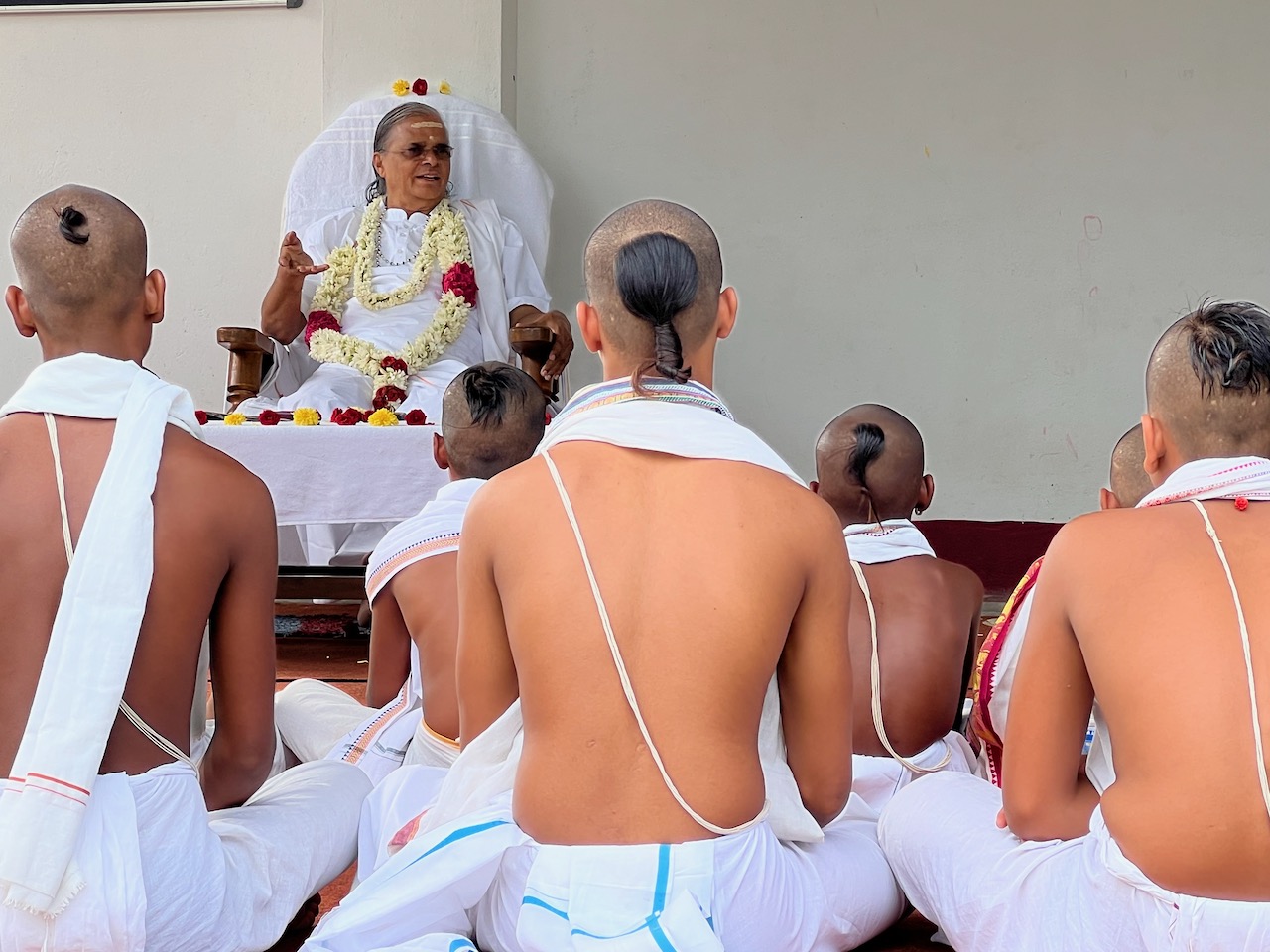
[From a December 2010 Interaction at Satyachetana Ashram, Tiruvannamalai, India.]