↓
 

Swami Sri Atmananda

Founder, Satyachetana International Spiritual Movement

Swami Sri Atmananda 
 
  • About
  • Contact
  • Links
  • Offerings

Post navigation

← Older posts
Newer posts →

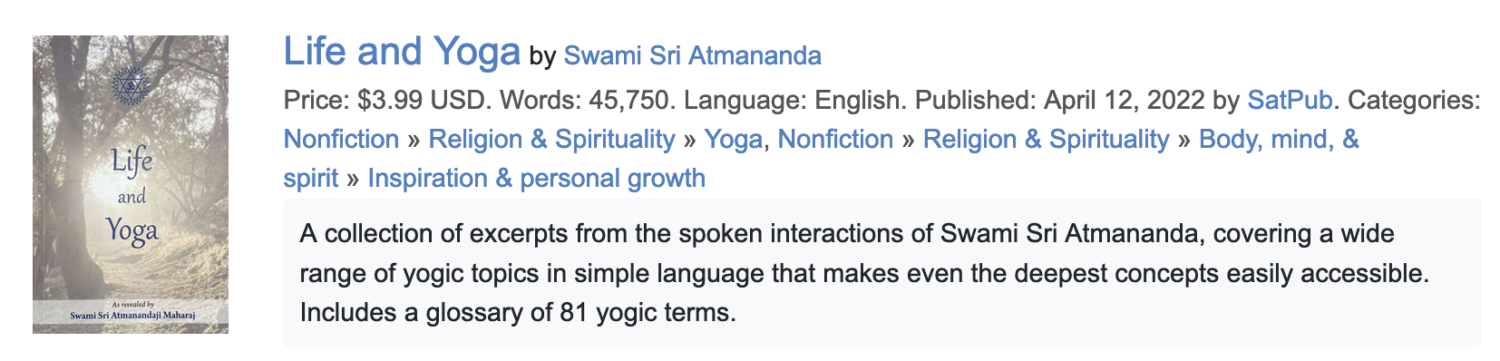
New Release: “Life and Yoga” eBook

Swami Sri Atmananda Posted on April 14, 2022 by SevaNovember 12, 2022

Omm Namo Bhagavate

Announcing the eBook release of Swamiji’s latest book, Life and Yoga, now available at Smashwords, Apple Books, Amazon Kindle, Kobo, Barnes & Noble and more. First page preview:

Peace, Love or Truth is not outside.
It is within you.
Find it, you will know what is silence
Experience it, you will know what is joy
Realize it, you will know what is enlightenment
Manifest it, you will know what is God.

Posted in Message Board | Tagged Gita Yoga, sadhana

Gita Path and Sannyasa Path

Swami Sri Atmananda Posted on April 4, 2022 by SevaNovember 12, 2022

Omm Namo Bhagavate

[This Interaction came after a discourse from a visiting Swami, who conveyed with joy and delight the perspective of the traditional yoga path of renunciation. After that, Swami Sri Atmananda said he would share the following, “Not to contradict anything Swamiji has said, because Swamiji represents a tradition which is honored in India from the Vedic time. After listening to him, I just feel to say a few words about the path we are following.”]

The traditional path of yoga emphasizes how this karmic world is a place of sorrow and misery, and the best sadhana we can do is find out how to get out of it.  The Gita as we have understood gives us a different message.  Although both paths justify their stance by quoting from the Gita, we see it from a different angle than the other paths.

Verse 371 is often quoted by those who follow the path of renunciation, or sänkhya.  It says that you have come to this earthly plane, which is transitory and full of sorrow: “Therefore, Arjuna, you should always pray to Me.”  The whole teaching of Gita is to show Arjuna, who represents all human beings, the path to quickly enter into Him who is the essence the whole creation.

When Krishna says, “Because you have come to this transitory, unhappy world,” he does not say to escape from here.   Krishna always says, “You have entered into the misery of this transitory existence, Arjuna.  Therefore enter into Me.”  Thus it is not an issue of how soon we get out of this world but how soon we get into it.  That refers not to this projected world, which is continuously changing, and not this shadow, which is the reflection of the reality, but to the reality itself: how soon we can enter into it.  That is, how soon can we enter into the consciousness of Krishna.

Krishna is in this this transitory world.  The very first verse of the Vishnu Sahasranam says, vishwam vishnu, Vishnu is inside this this universe: present everywhere but found nowhere.  Our problem is how to find Him.  When we do, we can merge in Him, and after that we can manifest Him.  The secret is this Vishnu who is inside this creation.  He has to be found through the act of invocation.  That is why Vishnu Sahasranam begins by stating that through the act of invocation, we can find this Vishnu, the Creator Himself.  Where?  Krishna says, “Arjuna, you can find Me everywhere and anywhere.”  In the tenth chapter He says, “Whatever is glorious, excellent, beautiful, admirable, or commendable, that is I.”  If you cannot find Him in that way, then there is a simple method as expressed in Verse 411: “This whole manifest creation is just a portion of me.”  That means the magnitude of the eternal consciousness is bigger than this creation, and bigger than the imagination of the human mind.  He is so big he cannot hide anywhere.  This is the approach through which we enter into this yoga.

Krishna has said only one thing: “Arjuna, attain Me.  I am everything.  Anything you can think, see, conceive or feel—everything is I.  Attain me.”

If all is He, the Lord, then one may wonder why the Lord himself said in several places in Gita that certain things are transitory and not real.  It may seem like a contradiction.  This question puzzled me for many years, until I found that He has never contradicted Himself.  He says, “I am both the unmanifest and the manifest.  As manifest I am the maya; as the unmanifest I am the reality.  What is seen in the outer universe is a reflection of the reality, so Arjuna, quickly attain me, the reality.  The most direct way is by simply loving me.  With the love of your heart, you can find Me, enter into Me, and you can be I in that form.”

This is the reason the twelfth chapter, The Yoga of Devotion, is the crest jewel in the garland of Gita.  Here Lord Krishna explains, ‘Simply by pure love you can find Me, recognize Me, enter into Me, mingle in Me, and manifest Me.  As you are searching for Me in every form, but not getting Me in any form, a time should come—and it must come in this life itself—when I will manifest through you, and all the forms of this creation should be able to recognize that.’

When Krishna is repeatedly telling Arjuna, “Attain Me, worship Me, think of Me and meditate on Me,” this “Me” is not the manifest form.  It is the unmanifest force.  How can we attain, find, mingle in, recognize and manifest that force if we constantly pray to the Lord to take us away from this transitory and unhappy world?  To find the force, be one with the force, wither away in it and ultimately manifest it, we have to retain our bodily form, and thus we have to take care of it.  To do that, we enter into this play of prakriti.  We must learn the rules of the play so that prakriti will not trap, veil and bind us.

This prakriti is the Lord himself.  As manifest He is known as the maya; as unmanifest He is known as the Supreme.  We have to find the approach to enter into Him without running away from Him. Krishna repeatedly urges, “Arjuna, before you become crippled, attain Me.  Don’t wither away in Me.  That’s not the purpose for you taking up so much pain as am embodied being.  For several lifetimes you have come and gone just for this one purpose.  Once you attain Me, I will manifest through you.”  That’s the central message of Gita.

Krishna has shown eighteen techniques to attain Him.  One is through extreme sorrow, if you have the strength to endure your torture.  That’s why the sorrow, dejection or despondency of Arjuna became the entry point to yoga in Chapter One.  When we experience sorrow, hardship or difficulty, we pray to God.  Great devotees have even prayed to the Lord to give them sorrow and problems, because they know that those situations link us with the Creator, whereas affluence, abundance, happiness and enjoyment take us away from God.

Another technique is to pray to God for pure philosophy.  This is the sänkhya path. Sänkhya says that prakriti derives all power from purusha.  Prakriti has no power by herself, but the purusha wrongly thinks that prakriti is the mistress and he is the slave.  Sänkhya constantly reminds a seeker that you are purusha, the real source of power; prakriti is only deriving power through you, so get back your sovereignty.

Gita rejects this.  In Verse 86, Krishna says, ‘What you just heard is from the angle of sänkhya.  Now I will speak from the angle of buddhi yoga, the yoga of intellect.  Prakriti has no power; she derives all her power from purusha, but prakriti has been powerful for many births.  Scripture says it is 8.4 million births, while the purusha has been powerless.  Don’t think that you can now make her powerless in a single birth; don’t waste time on that, Arjuna.  Just because you now know that you are the source of power and you ask prakriti to give it back, she will not listen to you.  Rather she will declare war against you, smash you and throw you.  Then you will again have to come back and this awareness will be gone.’

Lord Krishna continues, ‘Listen to Me.  I am showing you the intelligent way to get back your power without challenging prakriti.  Prakriti is attached to purusha; purusha is attracted to prakriti.  Prakriti has only this one weakness: because she is attached to purusha, whatever this purusha is asking for, she provides.  Therefore, apply your intelligence.  Don’t challenge her; she is mightier than you—the crippled, blinded purusha, who are devoid of all your awareness and strength.  She is the mother.  Be the intelligent child.  The first priority is, don’t be attracted to her at all.  Don’t create curiosity in her.  Allow her to do whatever she wants to do.  Never ask anything, because that is action.  Action always brings result, and through the result prakriti will bind you.  Next, never react to her, because reaction will make prakriti angry and she will smash you.’

Verse 511 says the purusha should deal with prakriti in five different ways.  First, remaining very close to prakriti, this purusha should always be a calm witness, never even whispering, “Why are you doing what you are doing?”  When this is achieved, one obstacle is gone.  Not only do you become the witness.  Next, you also give your consent to prakriti for whatever she wants to do.  If she wants to smash you, allow her.  Then if you become a real consenter and are not raising any objections, a second hurdle is gone.  There is a third hurdle, as the supporter.  Whenever you feel prakriti does not have enough strength, you give yours.  “My beautiful, loving mother, can I assist you, or do anything for you?  You want to trap me—okay, here is the rope.”  Become the supporter of prakriti and the third hurdle is gone.

Next, become the enjoyer without raising any questions. Whatever result she gives, accept it.  The last verse of the fifth chapter says that if you want to become the Supreme Lord of all the worlds you have to be the enjoyer of what prakriti is giving to you.  You cannot choose.  If you do, you cannot become the Lord of prakriti.  When you become the silent enjoyer, the fourth hurdle is gone.  If all four obstacles are overcome, then prakriti will see that you have overpowered her, not once but four times.  She will come and completely surrender before you, and you will become the great Lord of prakriti within you.

Here is a very small example.  Look at your own life.  I am becoming a close witness to what you are doing, never objecting or challenging.  I know what rubbish thing you are going to do, or what rubbish you are talking about me, but I never ask why you do what you are doing.  Next, I’m giving consent: “If she is doing that then let her do it.  That’s fine.”  Then I’m giving you the strength to do it and I am also calmly enduring the result of your actions.  Due to these four, you are surrendered to me.  Look at your life and you will see.  This is the reason; this is the secret.

If this is possible through a formal relationship, imagine what will happen if you apply this as a yogic technique: you are the great Lord and the prakriti within you will surrender to you, and then you will become supreme Self.

The purusha inside this body is verily the Supreme Purusha that has been completely attracted to prakriti’s attributes: her strength, beauty, knowledge and talent.  Anything that you can think, imagine, comprehend, feel—everything is prakriti.  Purusha is completely free from all these attributes.  If you still are not clear, read the seventh and tenth chapters of Gita.

When you stop being attracted to prakriti, you are overcoming prakriti.  When this is fully achieved, then this prakriti—who as Yogamaya was the cause of your bondage and your veiling—will take the role of Mahamaya.  Then she, the Mother, will work to manifest you, the Supreme Purusha.

Krishna taught this secret technique to Arjuna.  How Arjuna can go beyond each of his attractions and attachments is the yoga of Gita.  When Arjuna overcomes everything, then he finally says to Krishna, the Lord of yoga and the Supreme Purusha, “Lord, my attachment is gone; I have gotten back my awareness.”  By recovering that awareness, Arjuna gained what Krishna told him at the beginning of the fourth chapter: “You and I both have passed through many births.  You are Nara; I am Narayan.  In every transition we have come.  You are forgetting because you are coming through prakriti’s law, but I am remembering because I come due to my law.”  When Arjuna got that awareness back, it was a rebirth in consciousness, the rebirth without physically dying.  He realized that he was no longer bound by prakriti’s law, and then he said, “Now I shall do as directed by Thee.”

Is Arjuna now prakriti or purusha?  That’s the million-dollar question.  Krishna is the Supreme Purusha; Arjuna is definitely not the bonded purusha or the witnessing purusha.  So is he the prakriti, Yogamaya, Mahamaya—which form is he now?  The mission of the incarnation must wait until the collaborator is ready.  Arjuna has now become the collaborator, and it is Mahamaya, not Yogamaya, that collaborates with the Supreme for manifestation.  Arjuna is now the pure embodiment of Mahamaya, the Supreme Prakriti.  With the help of the Supreme Prakriti, the Supreme Purusha will reestablish dharma.

The message of Gita to us is, don’t be fed up with this world of transitory existence.  Don’t be identified with this realm of sorrow and misery.  Accomplish the mission of your life.  The opportunity has come to you after 8.4 million births.  After getting this human body, finding the path, knowing the secret, having all the physical strength to do yoga, and receiving the beautiful environment for perfection in yoga, if you cannot accomplish this mission, then the second option is better: get away from this.  Get out of this world of sorrow, misery and transitory existence and attain the bliss.  There are only these two ways.  No third option.

Each chapter of Gita shows us one exit point.  Through sorrow or through discrimination; if not discrimination, then through action; if not action, then through knowledge; if not knowledge then through inner renunciation; if not inner renunciation, then through meditation; if not meditation, then through the process of knowing the Self and the Supreme; if not that, then through devotion.  It goes on and on.  God has shown so many paths to run away from the clutches of His maya, but He has shown only one way to find Him, merge in Him and manifest Him before your hair turns gray—that is the state of becoming liberated while living.  Traditional yoga will say that after leaving the body you can go to this or that plane, but what’s the guarantee that you will definitely go to these theoretical destinations?  Alternatively, Gita says very clearly that verily when you are in the body—not after leaving the body—you can manifest Me, the Supreme Consciousness.

In Verse 84, Krishna told Arjuna, “If you win, you will enjoy the earth.”  If you attain supreme consciousness, you become another Krishna in a form, and you will enjoy everything that the whole earth has to give.  Whereas in the traditional path, if you are dead to passion, lust, greed, and anger, then in this life itself you will enjoy unending happiness and bliss.  But you have to be dead.  If you want to live and really experience everything, like Krishna experiencing everything, there is another way.  With Lord Krishna’s grace, we are aspiring to reach dynamic delight, so that we sing and dance and eat and sleep and do everything, but get contaminated with nothing.

[From May 2010 Interaction at Satyachetana Ashram, Tiruvannamalai, India.]

Posted in Experiential Guidance | Tagged renunciation, sankhya, sannyasa

Let Us Join Together

Swami Sri Atmananda Posted on February 26, 2022 by SevaNovember 12, 2022

Powered By EmbedPress

Link to World Peace Mantra

Posted in Message Board

Support the Forces of Harmony, Love and Peace

Swami Sri Atmananda Posted on February 26, 2022 by SevaNovember 12, 2022

Omm Namo Bhagavate

Announcement from Swamiji regarding the current global situation.

  • For more details, see the next post, above.
  • To hear a recording of the World Peace Mantra that Swamiji mentions, visit Satyachetana International.

Posted in Audio, Message Board | Tagged peace, World Peace, world peace meditation

In the Heart of Every Being

Swami Sri Atmananda Posted on February 8, 2022 by SevaNovember 12, 2022

Omm Namo Bhagavate

From a September 2012 Interaction at Satyachetana Ashram, Tiruvannamalai, India. 11 minutes.

Posted in Audio, Experiential Guidance | Tagged Krishna, manifestation

New Book: “Life and Yoga”

Swami Sri Atmananda Posted on January 10, 2022 by SevaNovember 12, 2022
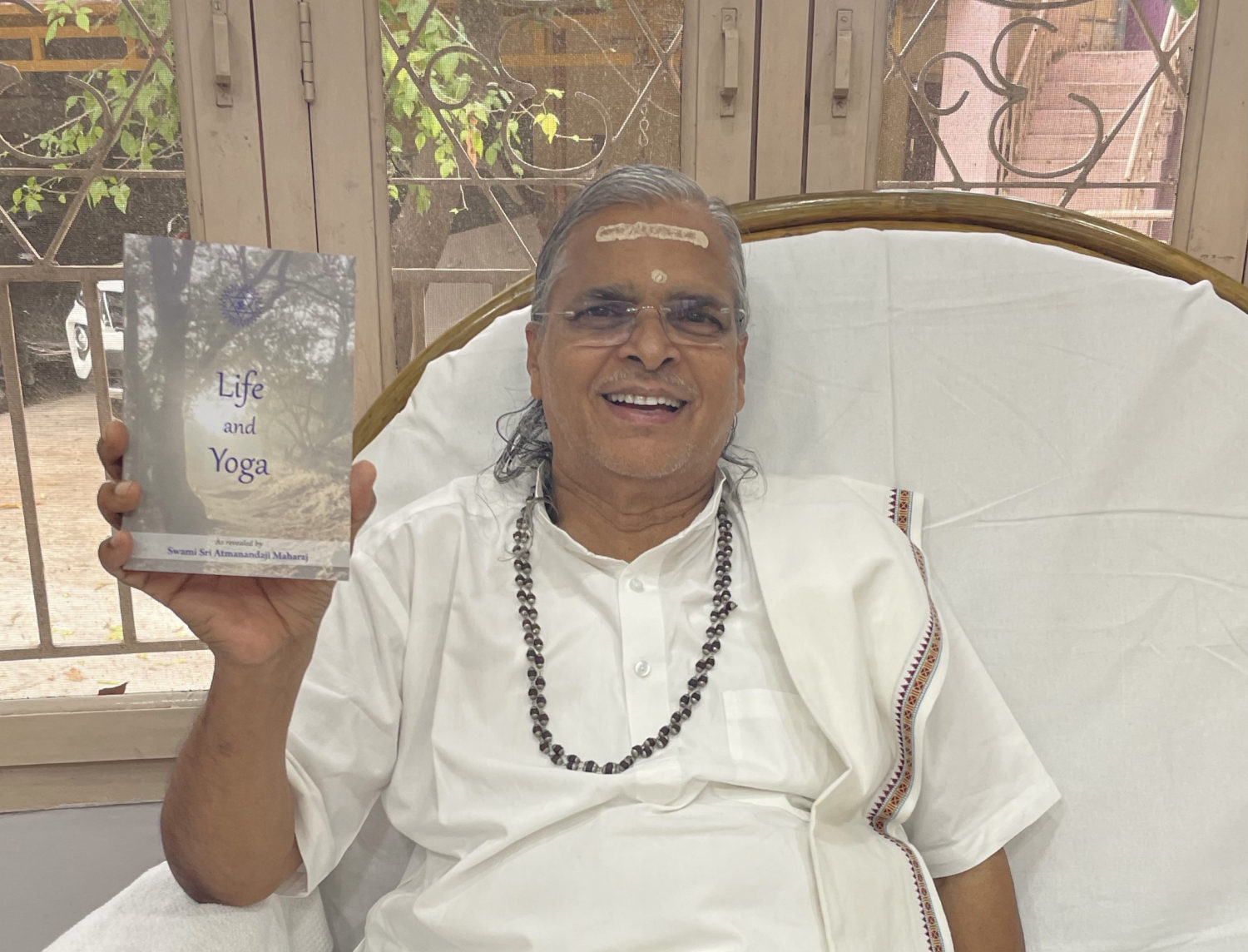
Swamiji displays the first copy of Life and Yoga,
before gifting it to Monisha, a visiting devotee.

Omm Namo Bhagavate

Announcing the USA edition of Swamiji’s new book Life and Yoga, now available for worldwide delivery. This collection of excerpts from Swamiji’s spoken interactions discusses a wide range of yogic topics in simple language that makes even the deepest concepts easily accessible. To order, visit Satyachetana Publications.

Posted in Message Board

New Year Message 2022

Swami Sri Atmananda Posted on January 2, 2022 by SevaNovember 12, 2022

Omm Namo Bhagavate

Message for the New Year 2022

Welcome all beings, Awakened Seekers, Enlightened Seers, Masters, Teachers and Light Workers, Lovers Of Humanity and Mother Earth.

I welcome all to enter with Me into this year 2022,
“The Year of Upheaval and Hope.”

Let us all transcend our individual Asmita, ego of the Lower Nature,
and enter into the Universal in us
and work for the great transformation of the consciousness on Earth
and collaborate with each other
to handle the pressure of upheaval and turmoil of 2022
with hope and determination.

Cling to the Universal if you aspire to be a collaborator,
or be prepared to perish!

This is going to be an extremely challenging year for all of us.

Let us Live for the Universal,
Live with the Universal.

Blessings and Love,
Bhagavan Sri Atmananda

New Year 2022

Satyachetana Ashram
Tiruvannamalai, India

Posted in Message Board

Action Without Attachment

Swami Sri Atmananda Posted on December 21, 2021 by SevaNovember 12, 2022

Omm Namo Bhagavate

The unwise always act with attachment, but the wise man should always act without attachment to ensure the maintenance of world order.

Srimad Bhagavad Gita, Verse 144

Karma, or action, has a purpose.  What is that purpose?  For an ignorant person the purpose is desire fulfillment.  If there is no chance of gain an ignorant person will not work.

If we ask this ignorant person, what is gain–is it an experiential concept or a concept of understanding, every ignorant man will say it is experiential. He may not know anything else, but he knows very well how it is going to benefit him or not.  Direct experience is a gain.  Gain and lose are relative experiential terms, not intellectual terms.

Action originates from experiential validation.  Without experience nobody will perform action.  The reason many people are not interested in action is because they are ignorant, and they do not find any chance of enriching, expanding, sustaining or perpetuating their experience.

This verse says that the unwise always act with attachment.  This attachment is to self-gain, result, reward and benefit.  Even a child is not willing to listen if you do not pamper and tempt him: “I will give you a chocolate, just run there and bring that thing.”  And child will run.

This means the embodied being may be completely deluded about the reality, but is always wise about one thing: the possibility of experience.  That’s the purpose for which the supreme Self (paramatma) became the individual self (jivatma) and entered into a human form in this material world.  That’s the main root from where this whole karma started.  The Brahman, the unmanifest, took up the form for the purpose of experiencing himself, the prakriti.  The manifest is the jivatma, the unmanifest is the paramatma, and experience is the key.  When experience is finished or transcended, the jivatma becomes paramatma.

If experience is finished, there is nothing more to experience, and the cycle is complete.  That is called liberation.  It is liberation from this cycle of unmanifest to manifest, to unmanifest, back to manifest.  This cycle continues as long as the experience remains incomplete; once the experience is complete there is no more coming and going.

Karma is nothing but desire that is stored up and accumulated, which has to be finished.  The mystery is that in the process of satisfying one desire we create another desire.  That is why this maze is never finished.

Liberation means to finish this desire for experience, which requires first switching off the process of manufacturing desire.  So experience must be finished, then only liberation is possible.  It can be finished three ways.  One is by experiencing it.  Second is by burning it through the fire of knowledge.  If this fire is constantly burning within, the moment the desires arise in consciousness they come into contact with this fire and are burnt.  Third is if it can simply be washed away through grace; that is bhakti.

The easiest and best way is to finish it through experience.  This is the reason the very first advice that Lord Krishna gave to Arjuna is to endure these experiences calmly:

Verse 61: Arjuna, the feeling of heat and cold, pleasure and pain, are caused by the contact of senses with the objects of pleasure.  These feelings are temporary and recurring in nature; therefore, endure them calmly.

Verse 62: O best among men, the wise men who do not get perturbed with this feeling of pain and pleasure are indeed fit to attain immortality.

Enduring calmly is possible only if you are prepared to go through the experience.  If you are avoiding experience, what is there for you to endure?  Therefore, allow prakriti to take you beyond experience through experience.  Don’t run towards pleasure, or away from pain.  If pain is coming, endure it.  That is Gita’s advice.

“O best among men” means the hero, the leader, and here Gita is talking of awakened beings, those who are yogis.  One who is the king among the yogis is the most awakened and most determined.  Such a person will not run away from the possibility of pain, defamation, torture, or hardship.  He will endure it calmly.

The unwise are ignorant about the process of karma: how it is created, how it is burnt, how it is washed away and how it is transcended.  You cannot renounce karma.  You can only suppress it.  That is why renunciation is a myth.  How can you renounce anything?

Verse 146: Actions are performed by the modes of prakriti, but the ignorant person whose mind is deluded attaches doership to every action and thinks, “I am the doer.”

All the actions are done by prakriti.  Due to ignorance the egoistic man feels, “I do it.”  One who says, “I am not going to do it,” is equally ignorant.

The concept of knowledge in Gita is not intellectual understanding, but experiential validation of the understanding.  If it has been experientially validated by you then that is wisdom.  So knowledge of Gita is called wisdom, and one who has this wisdom is called a wise man.  He is different from a learned man.  A learned man is a scholar; a wise man is a seer.  A learned man knows the scriptural meaning, the surface meaning, but a wise man knows the experiential meaning, the deep inner meaning, because it has been validated by his experience of life.

In Verse 144 when the Lord uses the word “unwise” this includes every category of learned men, from one who has just began to study scripture to one who is giving discourses on scripture.  These are different levels of ignorance.  Only when wisdom comes does action begin, and it is purified, profound action that dispels ignorance.  That is what Gita means.

Gita is a yogashastra, a scripture on yoga, and it has to be interpreted from the angle of yoga.  Yoga is not theory, nor a philosophy.  It is practice and a process.  My translation is a practical one that can show the path to one who really wants to enter into it.

Lord Krishna says, “The unwise always work due to attachment.”  For such people, the nature of their action is constantly busy.  If you ask them whether they are saturated with their karma, they will say no, and tell you their long list of responsibilities.  But if you ask a wise man, he will say, “My work is always complete.  I am simply responding to prakriti’s signal, doing nothing, simply responding.”  This will be the realization.

This ignorance I am referring to is not lack of scriptural knowledge, but lack of experiential depth.  The ignorant are constantly busy, always chasing pleasure or gain, fame or power, physical or mental or vital.  As they are constantly working, a wise man should also keep constantly working, but the big difference is that the first group works for self-pleasure and self-gain, while the second group works only for manifestation.  There is no other motive for the wise men.  And they are constantly busy.  The prime minister of a country is constantly busy, and an enlightened seer sitting in the solitude of a cave is also constantly busy.

When I was in the cave, sitting like a statue, I was constantly busy.  Whenever I was coming back to body consciousness, my thought was going towards the whole humanity.  I saw that the tsunami of ignorance had completely submerged the earth consciousness.  I felt that the monkeys who were staying with me in the cave were really liberated, but the human beings who were bringing me fruits or milk were completely deluded.  So a feeling of deep compassion was flowing and the thought that came was, how can the human soul be protected from this wave of ignorance that is surging ahead?

That was my thought every moment while I was in body consciousness.  Now also that is the only thought that is the source of my action drive.  Although there is no need and no compulsion, that is the motivational base of all my action.

That is Gita’s command in Verse 144: the wise man should also constantly act, never remaining in inaction even for a moment.  Why?  Lord Krishna says, for setting an example before others, and for sustaining and maintaining the world order.  If that motivation is not coming and you feel you have nothing to do, I will say, in the light of Gita’s revelation, you have not reached the highest state of realization.

Remaining in a human form, if even for a moment any withdrawal symptoms are coming to you, then you have not reached the highest state.  Krishna never felt frustrated in his life, even for a moment.  That is why he is the most perfect human being that ever came to Earth: no frustration, and never for a moment Krishna was having this thought, “I have nothing to do.”  That is why he is the highest ideal for every yogi.

In this verse, wise man means an enlightened being, the person who has fully understood the process and has validated it by his life’s experience.  Such a person should not withdraw from or run away from action.  He should constantly perform it for the sake of setting an example, and for maintaining world order.  That is Gita’s message for the masses, and Gita’s command for the enlightened seers.  This drive that one must work constantly should be retained until the last breath remains in the body.  Till that moment man should continuously work, because this is the field of karma, and this karma must be performed for manifestation of dharma.  If karma is not performed for manifestation of dharma then this field of action will become kurukshetra, the battlefield, and instead of becoming a valley of light and an ocean of love, life will become a battlefield of injury and death and disaster.

Every karma is a signal for expansion or a rope to trap you.  If karma is not coming to you don’t run after it.  This is natural law, prakriti’s secret.  Anything that is needed for survival is already given.  Understanding this secret, if you proceed on the track of life, keeping your awareness always in an expanded state, as this experience comes it will not overpower you.  That is the message I get from this verse of Gita.

If you are performing action for the sake of setting an example and sustenance of world order, then you are a wise man.  If you are performing action for any other purpose then you are not wise.  Maybe you are learned man, a noble man, a charitable person, a literate person, an intellectual, a philosopher, a swamiji, a guru, or god on earth, but Gita puts all of these in the category of unwise people.  This is the inner meaning of this verse.

It can be interpreted both as advice and as a command.  It is advice for those who are studying Gita as a scripture on dharma, but it is a command from the Lord for those who are studying Gita as a scripture on yoga.  This verse was a command for me: perform action continuously even though you have no compulsion.  This is the reason I am working twenty-four hours per day, and no one is able to know why am I doing what I am doing.

When you enjoy the solitude of your own silence a light will emanate from you—that is the light of your own self.  When this light is reflected on you that is called the state of bliss, ananda.  This is why enlightened beings are always in a state of ananda, and retaining that state when they enter into society to perform action they experience something higher than ananda: dynamic delight.

Action is performed by a wise man in a state of delight.  Whether fame or defamation comes, his state of delight is maintained, despite profit or loss, gain or pain.   Nothing affects his state of delight.  That is the secret of this creation.  This is why Krishna was always in a state of delight.  Krishna is not a man.  He was god in a human form, the first god to walk over this earth in a human body.  He has revealed this secret path to man so that every man can become god and walk on this earth.  That’s the purpose of Gita’s revelation.  And that is the purpose why I am again re-revealing it as per the need of the hour.

[From a March 2011 Interaction at Satyachetana Ashram, Tiruvannamalai, India]

Posted in Experiential Guidance | Tagged detachment, Yogic action

Post navigation

← Older posts
Newer posts →

Newest Posts

  • Carelessness Will Create an Explosion June 6, 2026
  • Two Types of Beings May 30, 2026
  • Don’t Volunteer Advice… May 23, 2026

Archive of Posts

Subscribe for Updates

BE SURE TO REPLY to the confirmation email—check your junk mail folder in case it goes there.
Loading
©2026 - Swami Sri Atmananda
↑
error: Content is protected
-