↓
 

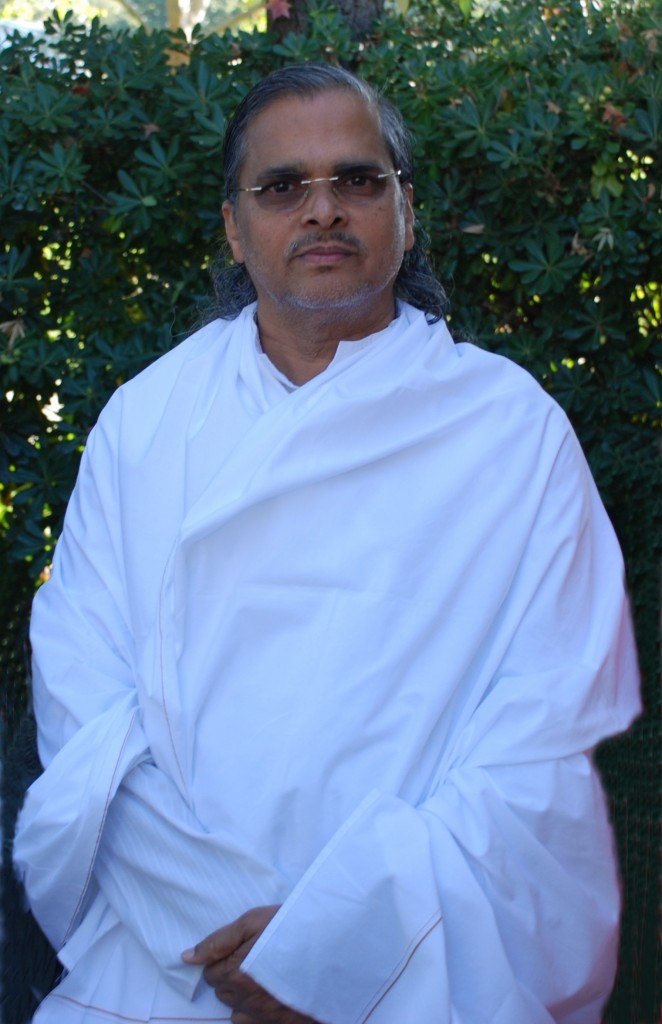
Swami Sri Atmananda

Founder, Satyachetana International Spiritual Movement

Swami Sri Atmananda 
 
  • About
  • Contact
  • Links
  • Offerings

Post navigation

← Older posts
Newer posts →

Gita Verse 101

Swami Sri Atmananda Posted on September 22, 2021 by SevaNovember 12, 2022

Omm Namo Bhagavate

In this verse, Arjuna is asking Krishna to tell him the symptoms of one who has attained the state of sthitaprajna, or equanimity. How is such a person able to retain that state? If he feels to speak, what does he say and how does he say it?  How can we know that a person has attained equanimity, and how can that person know that he has attained such a state? What are the inner experiences of such a person?

One may ask why such questions came to Arjuna. In the previous verse, the Lord said, “Arjuna, when your bewildered intellect will be free from contradictory statements and rests in the Self in a steady and undistracted position, you will attain to yoga.” Prior to that, in Verse 99, Lord Krishna said,  “When your intellect will be free from the mire of delusion you will have no interest to hear anything in the material plane, and you will have no identification with what you have heard.”

Naturally Arjuna must have wondered about that state to which Krishna was referring. Arjuna has not yet experienced that state but he has heard about it and seen some highly evolved spiritual beings. Now that he is in the battlefield of yoga and wants to reach that state, he is asking these questions.

Sthitaprajna depends upon the intellect, but first come the senses and the mind. The senses are very powerful. It is the dharma of the senses to run towards the object, but it is the duty of the yogi to restrain the senses from the object because the yogi wants to attain a higher state. If the senses are always allowed to run towards the object, the yogi will spend his life experiencing only the objects. Gita does not say that experiencing the object is not desirable. Rather, it says that you should experience not only the object, but also the subject.

The being came to the zone of experience to experience. This being in its pure state is only awareness, and entered the world of becoming to experience the becoming. While experiencing the becoming you should not lose the experience of the being. The entire essence of Gita yoga can be summarized with this single sentence.

When the being descended to the becoming and started experiencing the becoming, it gradually lost its own awareness. Yoga means to get back its own awareness of the Being, and it should happen while remaining in the becoming. That’s the whole purpose of yoga.

The yoga of Gita is not the struggle for renunciation or transcendence. On this path, the yogi must retain the state of transcendence even while experiencing the becoming–otherwise you cannot reach the highest goal of Gita. The state of transcendence must be retained. Beyond the gunas but on the gunas–that is the Purushottama state.

Compared to the sadhana of Gita, others yogas are just a chocolate or an ice cream. Other siddhis come very quickly, but the siddhi of Gita may take a lifetime or several lifetimes. However, Lord Krishna says you should achieve it quickly and fulfill the purpose of your descent. This is called the triple sadhana. Regaining the awareness is the first attainment, having the capacity to experience the becoming is the second, and third is while experiencing the becoming, you are not losing your state of the being. It is a long and very difficult sadhana. The yogi of Gita is required to have several attainments, several siddhis, and the first is the siddhi of equanimity. Without that, the yogi can never have other siddhis. If the equanimity state is attained, all other states will naturally come.

Sthitaprajna means one whose intellect is stable. Intellect is higher than the mind, and mind is higher than the senses. All the objects are external. You, the subject, have the instruments or avenues to experience that which is outside, and you have come to experience that. To do so, you have eleven components: five senses of perception, five organs of action, and one that controls those ten.

The five organs of perception are the eyes, ears, nose, tongue, and skin. These organs will tell you there is a beautiful object, a delicious dish, a soothing environment, and so on. The organs are not you; they are just your instruments. Through these instruments you get the idea of the object. Once you get the idea, you will experience the object. For that some effort is needed, so you are given the five organs of action: hands, feet, mouth, and the organs of reproduction and elimination. You are within the body, not inside your organs of perception, nor in the organs of action. The scriptures say you are in the innermost layer, in what some say is the heart, but it is not the physical heart. I have translated it as the core layer of consciousness. Consciousness is chit. So you, the being, are in the center of that chit, in the core layer. Remaining there you are experiencing everything.

The five organs of perception and the five organs of action are under the control of the mind. That mind is also not you. Mind is only one instrument through which you, the being, will experience the becoming. Mind, eyes, hands, nose, and ears–these are all instruments, given to you to enable you to experience the becoming without losing the state of the being. This is the challenge.

Gita says that if your intellect is stable you will be able to do this, and intellect will be stable if it is linked with the being, because the being is the only stable thing here. Everything else is unstable. Objects are unstable: they come and go, constantly changing, now they are here, next they are absent. Mind is also unstable.

The mind uses the senses, saying, “Go to that object,” and because mind is by nature unstable, it does not allow the senses to be stable: “Hey, come from there, go over there, go here, go there.” This is the reason man has so much fleeting thought. Mind does not allow the senses to remain on one object, so prakriti has kept mind under the control of the intellect. But what happens is, people do not use their intellect. Ninety percent of actions are performed only from the mental plane. That is called impulsive life, and indicates that a person is simply living on the surface mind. How can these people do yoga?

Gita says this type of person should be taught to discriminate, to take some time and think. Think what you want to ask, think what you want to see, think what you want to eat, think what you want to give, think what you want to receive. Make it a habit through practice. From practice you will go to jnana, that is, discrimination and contemplation. If you make it a habit you will see your nature begin to change.

Discrimination means you are beginning to use your intellect. Decay through disuse is the biggest problem. Misuse means you are using it in a wrong way. First begin to use it. That is the yoga. Now you are using only your senses and you are being used by the mind, and mind is unstable. The dharma of the senses is to run to the objects. Don’t blame your eye if it sees something alluring. Don’t blame your ear if it is hearing some distracting music. That is the dharma of the senses, and the dharma of the mind is to be restless. Neither blame the senses nor the mind.

You are different from the object and the senses, and you are not the mind. Your dharma is that you must use the intellect. You can use the senses, but due to their dharma they always run to the object, so you must restrain them. You can restrain them through your mind, but mind is unstable, so you cannot depend on it. Gita says, use the intellect. The intellect has the power to command the mind, and the mind has the power to restrain the senses. Apply your intellect to issue a command to the mind to restrain the senses. This is how the process goes. Intellect does not directly command the senses. This has to be understood. Activate your intellect. Once you use the intellect, it expands.

This is why Gita first taught of the concept of the being, the soul, to make you aware that you are that. Your whole sadhana of Gita rests on the foundation of the concept of soul.  You have to experience this concept to be grounded on yoga. To do so you need to complete six stages, until the sixth chapter. That is why Krishna is saying that when your intellect will be linked with the being, with the soul, and not with the mind, then you will begin to experience stability.

The intellect should be always linked with the Self, not with the non-Self. Then it can command the mind to allow that experience for a length of time that will not take away your awareness.

I had not explained the concept of sthitaprajna before this because I wanted people to first have experiential depth. Prajna, or intellect, will be stable if it is linked with something that is not moving. In the very beginning, Krishna explained the component that is unmoving, imperishable and neither comes nor goes.

“These bodies are perishable but not that which dwells in them. Bodies come and go, but that which dwells within never comes or goes. Neither you nor I nor any of those who are standing before us have ever gone. They were all here, we are all here, and we all will be here. What comes and goes is the body.”

He blasted something that the intellect cannot comprehend and the mind cannot hold. Then drop-by-drop he started injecting how this abstract concept can be experienced. If you are able to experience one drop of it, you have entered into yoga. If you are not able to experience even that much yet you are capable to give discourses up to the eighteenth chapter, that is called intellectual rubbish.

Equanimity is a big attainment, but in the language of Gita’s attainment it is a drop, just an ounce, because that’s the first attainment. That drop can make your intellect stable, and make you a sthitaprajna. Arjuna had experienced that, but he was not able to retain it. It comes and goes. That is why he is asking how to retain it and what is the nature of the samadhi state. Samadhi at this stage is not a static concept. It is dynamic, fluid, and not yet stabilized. Stable samadhi, or the Self-realization stage, will come in the sixth chapter. But here in the second chapter, the moment you are linked with the being, that is, you are experiencing the being, this type of samadhi comes. It may remain one second or one minute, but it comes.

Do not commit the mistake of concluding that the intellect getting linked with the self means twenty-four hours per day, three hundred sixty-five days per year. It gets linked but since it is not stable, it again gets delinked. At this stage the experiential depth is so tiny, like a droplet, that the experience is swallowing this drop of awareness.

That is why a yogi of Gita should always remember: thus far, no farther. Stop the experience the moment it threatens the entire awareness. When there is too much turmoil, I just go and lock myself off and become delinked from everything and everyone. I enter into Me and then I get back my state. When my battery is recharged, I come out again. The result is that I don’t care about success or defeat, profit or loss, fame or defamation, acceptance or rejection, because the intellect is linked with the Self.

When a man is using his intellect regarding how to enjoy the objects, his intellect is not linked with the Self. Objects are varied and perishable, not constant, and if the intellect is linked with that which is unstable, it will also naturally be unstable. But if the intellect will be linked with that which is stable then the person will be heading towards equanimity. That is what Lord Krishna says in the verses 99 and 100.

Verse 99 states that when your intellect will cross the mire of delusion you will be indifferent to what you hear and what is yet to be heard. Your organ of hearing is used for external hearing and material dialogues, but when your intellect will be free from this, you will begin to hear the voice that speaks to you within.

The words you are hearing, that I am speaking to you, are not important, but by hearing them something is starting to speak to you within, and you are able to hear that. When you will be able to perfectly hear the voice of the being within, there will be no need for you to hear me or anyone else. Your response will not be affected by what you hear because the inner voice will tell you how to respond.

The next verses show how the sthitaprajna is able to retain that state, not losing his quota of equanimity while interacting with others. You may notice that you are likely to lose your state after you talk to someone. The more you see that, the more you avoid talking to that person. It happens naturally. That is not repulsion. Repulsion is different from withdrawal. People in our group withdraw when they see that their system cannot handle something. You do not have any hatred, anger, or bad feeling for that person. You simply experience that your state is getting diminished and you are losing your equanimity, so you apply your discrimination and avoid a situation that exposes you to that person or situation or environment. That is yoga. That’s the proof that you are conscious of your sadhana. With some people you start talking about mundane things and while talking or performing ordinary tasks your consciousness goes very high. But with some people, even if you talk of yoga and scriptures, you feel that your energy is completely gone, you feel lifeless. This happens because words are not important. What is transmitted through words is important. Everything in the ultimate analysis is nothing but energy, consciousness.

Experiential understanding is the key to reach the goal in Gita. If you put emphasis on mind’s understanding you will become just an intellectual, a professor of yoga, but not a yogi.

[From a November 2012 Interaction at Satyachetana Ashram, Tiruvannamalai, India.]

Posted in Experiential Guidance

Beyond Yoga Siddhi: Session 5

Swami Sri Atmananda Posted on September 12, 2021 by SevaNovember 12, 2022

Omm Namo Bhagavate

Part Five of this series is now live on YouTube: click here or view it below. To visit or subscribe to the Satyachetana channel on YouTube, click here.

Posted in Experiential Guidance, Video

Beyond Yoga Siddhi: Session 4

Swami Sri Atmananda Posted on August 27, 2021 by SevaNovember 12, 2022

Omm Namo Bhagavate

The fourth in Swamiji’s new series of interactions is now live on YouTube. To view it, click here or watch below. To subscribe to the Satyachetana channel on YouTube, click here.

Posted in Experiential Guidance, Video

Universal Yajna

Swami Sri Atmananda Posted on August 26, 2021 by SevaJuly 26, 2024

Omm Namo Bhagavate

Swamiji explains the upcoming Brahma Kunda Yajna and its fire that will burn 24 hours a day, 365 days a year. (Recording of global announcement on 22 August 2021 via Zoom.)

Posted in Audio, Experiential Guidance, Message Board

Secrets of the Path, Episode 6

Swami Sri Atmananda Posted on August 19, 2021 by SevaNovember 12, 2022

Omm Namo Bhagavate

Episode 6 of Secrets of the Path can now be viewed at YouTube. Here is the link. These videos will now be posted only at YouTube, so to be informed of future updates, subscribe to the Gita News Network channel.

Posted in Message Board, Video

Nonviolence (Ahimsa)

Swami Sri Atmananda Posted on August 16, 2021 by SevaJuly 26, 2024

Omm Namo Bhagavate

Swamiji’s address to the students at the Universal Veda Gurukulam on Indian Independence Day, 15 August 2021.

Posted in Audio, Experiential Guidance

Beyond Yoga Siddhi: Session 3

Swami Sri Atmananda Posted on August 15, 2021 by SevaNovember 12, 2022

Omm Namo Bhagavate

The third in Swamiji’s new series of interactions is now live on YouTube. Click here or watch below. To subscribe to the Satyachetana channel on YouTube, click here.

Posted in Experiential Guidance, Video

Gita Verse 243

Swami Sri Atmananda Posted on August 9, 2021 by SevaNovember 12, 2022

OMM Namo Bhagavate

While practicing the yoga of ceaseless union with the Self, one should avoid crowded places and try to live within, banishing all ideas of material possession.  One should also remain free from desire and control the senses. 

Srimad Bhagavad Gita, Verse 243

Remaining alone, the yogi should always strive to be linked with the Self.  To do this, certain conditions need to be fulfilled.  First is to remain in a state of not consciously activating any desire.  Desire-prompted actions must be minimized day-by-day. If you are creating or responding to desire-prompted action, you can never enter into the Being.

There was a time I was dead against carrying food with me. I would prefer to remain hungry rather than carry food.  I was always saying, a sick man carries medicine wherever he goes and an indulgent man carries food wherever he goes, but a yogi carries nothing.  Whatever is available he will eat.

I realized this at a young age because when I was a child and staying in the school hostel, every time I visited home my mother would make a huge variety of cakes and treats and fill a whole box for me.  Until that box was finished my mind would never stay in the class.  I would be in the classroom, but thinking of the sweets and biscuits, because children love food.

One time when there was recess, I came running to the hostel to eat a particular item I had hidden under the bed because there were two boys that were determined to eat all my food.  As I was eating it, one of my friends came and tried to snatch it from me and it fell on the floor.  Neither of us got it.  That made me angry and we quarreled, and I forgot about my next class.  By the time I came running, three-fourths of the class was over.  My teacher was very strict.  When he learned of the situation, he told the other boys to write a big sign that said, “I am greedy, I can compromise everything for food,” and he hung it on me, with instructions not to remove it until the end of the school day.  I was constantly crying, because other children were laughing, and that was very big insult.

I learnt the lesson that I must not carry food with me.  I made a promise.  But my mother would not listen to the promise, and kept giving me food, and I did not want to hurt her feelings.  So as I walked to the bus stand, I would distribute the food to whoever was walking on the road.  I was so determined that this practice remained right up to the end of my student life and beyond.

I share this because these small examples from my life will show you how even as a child I was conscious of sadhana.  I am not telling this to just make you feel that I was a very great yogi, but to inform you that these are all natural tendencies, and if you will be determined you can overcome them.  These took me many years to overcome because I was a child, but you are not a child.  You are an adult and a consciously striving yogi, so if you will apply your willpower you can definitely overcome these tendencies.

Any object that can activate your senses or fuel your desire for enjoyment should not be kept with a yogi.  A yogi must go through that stage when he is not keeping with him anything that is considered unnecessary for yogic life.  This is the reason when I was in this stage I took away my mattress and made the body sleep on a wooden plank.  I pledged that if I am hungry, food must be available wherever I am, because it is prakriti who is creating hunger, not me, so she must make food available.  If not available, let me die.  That was the intense feeling with which I was following my path.

Now if you go to my room you will see in my cupboard two dozen sets of clothing, but right up to my marriage I had only two sets.  I did not have a third set, although I could have afforded fifty.  I was so determined.  Two pants and two shirts—that’s all.  Each night I would wash and dry one set.  My entire student life I was never wearing cloth that was pressed or cleaned by someone else.  I had money, but it was a question of self-reliance, not of money.  My principle was not to unnecessarily take help from others.

The determination must be there, and as per Gita, all this is the preparation for Self-realization.  Without Self-realization you cannot go towards merger, without merger you cannot go towards gunatit stage, and without gunatit state you can never manifest Divine.

These are the conditions.  First, you are living within: surrounded by all, but identified with none.  You are alone, because you have to transcend this world of mind and senses.  Second, you are consciously restraining the senses from their natural flow towards the object.  Senses, mind and the vital will run on their natural way, but you consciously restrain them.

When you practice this type of sadhana you will experience five stages.  First is the unstable state of the mind.  In this state, the moment you want to focus, and take the mind away from something, the mind will run towards that.  If you are not consciously making this attempt the mind is silent.  But the moment you focus to take it away from something, the moment you want to tame it, the mind will become more turbulent.  That’s the first stage of mind control.

Both determination and discrimination are necessary.  You have to apply your buddhi yoga to find out how your mind will be less powerful than you.  Mind gets more powerful when all the senses are active, which means the mind is using all these five senses to smash you.  Try to neutralize the senses one by one.  Begin with the weakest and go to the strongest.  You may say, “My sense of smell is not troubling me.”  It may not be, but it has the strength to create nuisance in you.  So you have to tame it.  Just because it does not seem to be troubling you, don’t take it for granted.  When it will join with the other senses it will really contribute in its own way to destabilize you.

When you consciously control the senses one by one, you will notice that you are entering to the second stage of mind control.  From the unstable state the mind will come to the delusion state. When you want to sit and meditate, you will experience that drowsiness comes, and that will push you to the sleep stage.  Your mind will not listen.  Sleep and sloth will come.  In your day-to-day activities, work will pile up, and although you will feel to do something, you do not find time.  That’s the second stage.  You have to overcome this.

When I was in this stage I would write down a list of works on a piece of paper and keep it in my pocket.  There might be twenty tasks to be done, but I will write the five or ten most important works for each day. I was not always able to successfully complete them all—like if I noted down five tasks, I might be able to do only three—but the very fact that I was noting them down and keeping a record, that showed me the track, and I could clearly see that I was making progress, and see my path.  First it was zigzag, then it became linear, and finally it turned upward and ascending.

I have never done yoga theoretically.  I have done it practically, and these are my experiences.  Write down the tasks.  In the beginning stage don’t mention at what time you will do each one, because you have not come to that stage that you will be definitely able to stick to the time.  But mention the work.  Until you have mastered your mind, and have control over your time, don’t give a specific time.  Rather, tell others to give you a time, and ask for a range, like, “Between eight and ten o’clock.”

Next comes the third stage of the mind, the disturbed state.  In this state you are able to focus and concentrate, but something happens to divert your attention and after that you are not able to regain your concentration. From this you go to the fourth stage of the mind, the concentration state.  Now, even if a distraction comes while you are focused on something, you are able to again concentrate without much difficulty.

Then comes the still and stable state, which is the final stage.   Here your mind will be always linked with the Self within, but your outer activities will continue.  Mind has two layers, the surface and the inner.  Surface mind is the monkey.  Inner mind is the elephant, very stable.  The inner layer, or the inner mind, is linked with the Being, and is stable and silent, while the outer mind is discharging the activities.  If you minutely examine you will see that ninety percent of the work can be done with your surface mind.  The inner mind is used when you sit quietly and try to contemplate. Then your inner mind is getting linked with the outer problem and when that happens the solution will become visible.

When one is doing yoga he should minimize the activation of the surface mind. This is the reason we go to stay in ashrams.  The surface mind is activated when you are engaged in surface conversation, so yogis should not engage in unnecessary discussion with fellow yogis.  When we talk, we share our physical, mental and vital experiences, our ideas, opinions and thoughts.  Rarely people share their realization or their sadhana experience.

Here in this verse the Lord is advising how a seeker should proceed towards Self-realization, and what are the necessary preparations.  First is, remain within yourself.  You may be in an ashram, where twenty-five people are staying, but be within.  Live within.  Avoid socialization and gossip.

Always consciously strive to control your mind and your vital.  Of these five stages, find out at what stage is your mind.  If you are in the stable and still state, you will notice that those who are in an unstable state won’t feel the pull towards you.  They will have either fear or reverence, because you will radiate a certain vibration that will repel other energies.

Put conscious effort to control your mind and your vital.  Don’t activate your desire force, and don’t keep unnecessary things with you, especially if you are in a state where you are entering into the Being.  The outer world is a world of excitement only.  The inner world is the world of bliss.  Once you experience the bliss of the Being, outer excitement will not pull you.  That is what Krishna says, that senses will always run towards the object, and how far will outer denial take you, Arjuna?  If you can experience the Being within, the senses will turn away automatically.  This is the advice that was given in the second chapter.  And in the sixth chapter the sadhana procedure is explained step-by-step.

Once you enter into the Being you experience the Being, and that is nectar.  Once you experience that you will be pulled towards it again and again.

A yogi should always consciously strive to be linked with, and enter into, the Self.  For that the yogi should follow four conditions:

  1. Live within, by yourself
  2. Consciously put effort to control the mind and the vital
  3. Do not activate the surface desire mind
  4. Do not keep unnecessary objects with you.

If these four are followed then entering into the Being and remaining with the Being will be easier.

[From a February 2012 Interaction at Satyachetana Ashram, Tiruvannamalai, India.]

Posted in Experiential Guidance

Post navigation

← Older posts
Newer posts →

Newest Posts

  • This Cobweb of Karma May 2, 2026
  • A Yogi Responds; a Yogi’s System Reacts April 25, 2026
  • You are linked with what? April 18, 2026

Archive of Posts

Subscribe for Updates

BE SURE TO REPLY to the confirmation email—check your junk mail folder in case it goes there.
Loading
©2026 - Swami Sri Atmananda
↑
error: Content is protected
-