
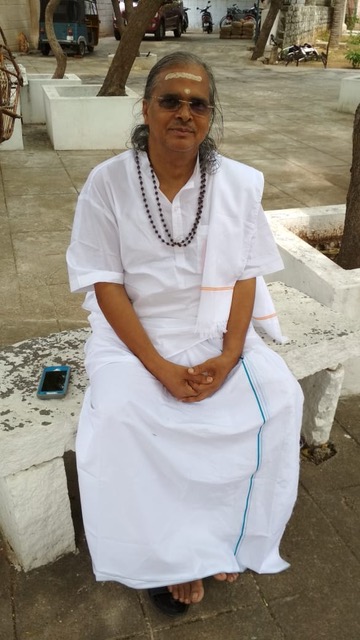
Omm Namo Bhagavate
Bhagavad Gita verse 103:
duhkheshvanudvigna-manäh sukheshu vigata-sprihah vïta-räga-bhaya-krodhah sthitadhïr munir uchyate. [2.56]Arjuna has asked how can one know who has attained the state of sthitaprajña. Sthitaprajña we have translated as the state of equanimity. One whose prajña is fully established in the being is sthitaprajña.
Prajña here is not the surface intellect. I have given a new term to this: creative intelligence, that intelligence which decides what is right for a seeker. This creative intelligence, this prajña, is not found in those who are leading a gross material life. They are just working from the plane of normal human intelligence. Animals and birds also have some type of intelligence. Human beings have higher intelligence but that intelligence is used for interacting in the gross material plane. The animals and birds use their intelligence for living.
Those who are only identified with gross living have no higher purpose. Higher purpose does not mean to become a scientist or a professor or an engineer. It means to establish a connection with the atman within, the paramatman within, and to dedicate life to living with spirit, living for spirit. The lower purpose is to lead a happy life in the material plane.
The true purpose of life is to live for God. How can one move towards that purpose—who gives guidance? It is the higher intelligence, the creative intelligence, not the surface mind, that guides the seeker to be able to discriminate between gross human life and elevated spiritual life; it is not discrimination between gross human life and dignified human life.
Who arrives at this conclusion? In the human system there are several components: the gross physical that is dominated by the senses; the lower mental that is dominated by thought and memory; the lower vital that is characterized by feeling and impulse; and the higher vital that is characterized by aspiration for a spiritual life, ambition for spiritual realization and strength to pursue the spiritual goal. Then there is the higher mental that is full of godly thought and godly intuitive memory; the sadhana that is done from a previous life is higher mental. Finally there is the psychic.
The intelligence that gives the conclusion for gross human life is just above the lower mental, but the divine intelligence that guides human beings to arrive at a conclusion for a higher spiritual life is above the higher mental. The intelligence forms the conclusion and a yogi goes by that conclusion and knows what to do, and how and when to do it.
Human intelligence is resting on the mind which is a monkey, jumping every moment, but the divine intelligence is linked with the being within, which is constant. The Blessed Lord is referring to that when Arjuna asked, “Tell me, Lord, how can I know who is that person who has attained stable intelligence?” If the intelligence is stable, actions will be transparent, and there will be no confusion and no contamination from the world of prakriti.
The Lord explains that the one who is established in equanimity, whose intelligence has become stable, is not perturbed by dukha, sorrow. What type of sorrow is referred to here? This is the second chapter of Gita; the yogi has just entered into the second step in sadhana. We have divided each chapter into a step, and as the yogi ascends to higher and higher steps of sadhana, he becomes more stable. Here at the second step of sadhana, the yogi has gone through dejection and is now learning discrimination through buddhi yoga. The Lord is revealing characteristics of the person who is capable to discriminate: what are his inner experiences, what are his outer symptoms, how can a beginner know whether he is able to discriminate between Self and non-Self, matter and spirit, sadhana and indulgence—how can he know that he has come to that stage? The Lord is also explaining how Arjuna can know from the outer symptoms that a person is established in the state of equanimity. Both are necessary in yoga, because if the yogi is able to know from inner experience what are the signs of equanimity it will give him strength and inspiration to proceed further. The outer symptoms are necessary because the yogi of Gita does not live in a forest or in a cave and has not renounced samsara.
The yogi of Gita is within samsara. That is why Gita was revealed in the battlefield, not in the ashram of a hermit or a saint. Very symbolic. The battlefield refers to the turbulent, chaotic life in samsara. Arjuna was a householder who was pushed by prakriti to perform his ordained duty as a kshatriya. Gita is the yoga of the common man living in society, facing this turbulent, chaotic world of samsara, so how can the yogi perform sadhana? If he is called and chosen and awakened, remaining in samsara and the material-social world of relationship, how can he proceed? That guideline is given in the yoga of Gita.
It is necessary for Arjuna the seeker to know the outer symptoms, because if he is able to recognize a person by his outer symptoms—“Yes, here is a person of equanimity, here is a person who is able to clearly discriminate between sadhana and enjoyment, Self and non-Self”—then he will establish a connection with such a person. Although yogis live together, actually they live in themselves. So in the outer social life, if the yogi is able to recognize who is a seeker like him, who is on the same path like him, then at the time of confusion he can seek guidance from such a person. He can share his experiences with such a person. The common man will not understand what is happening to him.
This is the reason the Lord is explaining the inner experiences and outer symptoms of a yogi on the path of Gita. The Lord says, duhkheshvanudvigna-manäh, such a yogi is not perturbed when he is facing a situation of sorrow. Sorrow is of several types. It can be psychic, that is adyatmic dukha, or vital, pranic. When someone in the family dies, when a friend meets an accident, when something is stolen which you like very much, when someone shouts at you without your having any fault and you cry, you get angry—these are the examples of sorrow in the vital plane. Sorrow in the physical plane is called pain. Sorrow in the mental plane is depression, and when it touches the vital it becomes intense. Depression first begins in the vital then comes to the mental. When the mind is overpowered by this depression that is originating from the vital, a person feels suicidal tendency. When there is sorrow in the psychic plane, you cry without any reason.
What type of sorrow is the Lord referring to here? Remember the yogi is in the second step of sadhana. This yogi is awakened to the inner reality, but does not know it through mind yet. He will know it only when the Lord will reveal it, when the guru will reveal it. The guru of Gita has not revealed it to Arjuna at this point, so he does not know that he is awakened.
If we see from the point of yoga this is the second chapter, and yoga begins with ascension of kundalini, the chit. Chit from the muladhara, the first chakra has come to the swadhisthan, the second chakra. When the kundalini is in the muladhara, man lives the life of an animal, only for eating, sleeping, and enjoying. He leads a life of fear and indulgence.
When the kundalini moves towards the second chakra the person feels a pull towards sadhana and also a pull towards samsara, a pull to the world of senses and also to the world of the Self. You cannot say what will happen to such a person. Kundalini rises, again it falls. This process may continue for many years. When it comes back to muladhara, life is a life of enjoyment, running with friends to see an exciting film, to enjoy good food in a restaurant, mixing with politicians for a political speech. Then when it rises a little, running to ashrams to listen to the saints. That’s the movement of the chit when the chit comes three-fourths towards the second chakra.
The second chakra is where the kundalini should remain for a human being. If it remains there, that human being will be an ideal citizen, but may not be a spiritual seeker. Yoga, the journey towards the Self, begins only when the kundalini starts to leave the second chakra and moves towards the third chakra.
Here in the second chapter of Gita, the kundalini of Arjuna the seeker is in the second chakra, because Arjuna was an ideal citizen. He was the best among the human beings of his time. When the kundalini is in the second chakra the person will lead a dignified but simple life. Now the kundalini has started moving towards the third chakra, that is, the manipuraka, the seat of the fire element, and turbulence begins. At that time a person becomes a jijñasu, a vairagyi or he experiences dejection.
One can enter into yoga through three gates, either through jijñasa, vairagya or vishäda. Arjuna is in the battlefield. He has no knowledge of yoga. He has knowledge of warfare, ethics, morality and idealism. Suddenly, in a very unlikely environment the kundalini movement has begun vigorously. Why? First, Arjuna is in Kurukshetra, a very powerful and holy place. Most importantly, Arjuna was too close to Krishna, the Supreme Being, although Krishna has not yet revealed who he is. Arjuna knows Krishna is his cousin. In his mental plane Arjuna might know Krishna is god, but knowing in the mental plane makes no difference. Sadhana is not through mind; sadhana is a struggle to go beyond mind. Sadhana is through psychic. When psychic will overpower mind, vital and senses, then the real sadhana begins.
This Krishna in the battlefield is different from the Krishna that Arjuna had seen before. Krishna at the battlefield is known as Yogeshwara, the Lord of yoga. Krishna has gone to the battlefield with his full power of the Supreme Being. Arjuna’s system was pure, his chit was in the swadhisthan, and suddenly due to the physical proximity to Krishna, the Supreme Being, and due to the impact of the holy place, Kurukshetra, Arjuna’s kundalini started moving towards the third chakra vigorously. Swadhisthan is the water element, and manipuraka is the fire element. If you move from water to fire, from cold to heat, what will you experience?
Everything we experience, everything we feel, everything we think, whatever we understand, it is all in the realm of chit, prakriti. Only when we become aware—awareness without experience—that’s the realm of Sat, that’s yoga. When you are aware, but you are not experiencing anything, that is samadhi: your individual soul is connected with the universal Soul.
Suddenly Arjuna was experiencing many things that his mind was not able to understand, which his intellect was not able to comprehend, because the chit was moving towards the third chakra. The chit is the seat of all experience; the Sat is the seat of all awareness. Now Arjuna is experiencing what we saw in the first chapter. Dejection becomes total and sudden, and within that little time, the movement of kundalini from second to third was complete. So rapid was the movement that Arjuna, the greatest warrior of his time, was not able to handle this pressure and his system collapsed. He could not think coherently, his intellect could not guide him, his vital started feeling a tremendous turbulence between the enemies and the relations, and even his physical was weak. He could not lift his bow, he started feeling a burning sensation and his head was reeling. The kundalini moving from second to third chakra normally takes three years, but for Arjuna maybe it took ten or fifteen minutes. How long does it take Arjuna to look at the enemies on the opposite side and see who they are? He already knows who they are, so it must have taken just a couple of minutes. Meanwhile Arjuna is less than three feet away from Krishna in the chariot, and that cosmic radiation from Krishna’s gross physical body is activating the chit within and the yoga process has started.
It was extremely painful for Arjuna because he never wanted to be a yogi. Arjuna, the seeker, is in the second stage; he still does not know. He has said, shishyas teham shädhi mäm twäm prapannam, “I am thy disciple, I surrender at thy feet, guide me on the correct path.” He might have said it, but who in Arjuna said it? The mind in Arjuna said it, and the mind did not know why he is speaking that. If he had known it correctly, then after saying this he would not have again argued with Krishna, because a disciple, once recognizing the sadguru, never argues. He blindly obeys. But we are seeing Arjuna still arguing, still trying to justify.
Arjuna is in the second stage, learning how to discriminate, not yet fully stable in discrimination. When he is stable he will pursue the sadhana, and Krishna will teach him the secret of yogic action. That will wait until Arjuna comes to the third stage of the journey, the third chapter of Gita, the yoga of action. Here he is asking, “Tell me how I can know I am in the state of sthitaprajña.” That means he has not had the experience. “Tell me how I can recognize someone who is a sthitaprajña.” One who has the experience will not ask what are the inner experiences, because he is having them, and one who has the inner experiences will not ask how he can recognize one who is having that experience.
The Lord says, duhkheshvanudvigna-manäh, unperturbed by sorrow. What type of sorrow? The sorrow in the social-material plane. Arjuna is yet to know what is psychic sorrow. He has not come to that stage. This is called in our scriptural terminology adibhautic and adidaivic dukha, not adyatmic dukha. It is not spiritual sorrow. When such a seeker is facing sorrow, he is unperturbed because he is established in prajña, the higher intelligence. His prajña is linked with the being, the atman. One whose intellect is linked with the being, not with the mind or the vital, does not feel perturbed when faced with the situation of sorrow.
Next is sukheshu vigata-sprihah. Asprihah means attraction towards happiness. There is no attraction towards happiness or the possibility of gaining something. You got a million dollars, you did not feel elated; you lose your million dollars, you don’t feel perturbed. That is the state of equanimity, the state of sthitaprajña. It is not a small attainment. Not feeling any attraction towards happiness in the material, social, mental world, nor feeling any perturbation when faced with a situation of sorrow, loss, deprivation, defamation: that’s the state of equanimity.
Then comes the third condition, vïta-räga. Here räga is attachment, not anger. Vïta-räga means attachment to your near and dear ones. Try to understand how I am interpreting. Free from attachment does not mean detachment. Detachment is a long way to go. A sthitaprajña person has attained freedom from attachment. Not getting identified with, nor being pulled towards the near and dear ones, kith and kin.
Then comes freedom from bhaya, that is, fear. There can be three types of fear: fear of material deprivation, fear of losing honor, and fear of losing near and dear ones. These are the material, mental, social fears, not the fear of losing your attainment.
Next is krodhah, anger. Anger comes when desire is obstructed. A person who has attained the state of sthitaprajña does not have anger due to material, social, mental, or vital causes. He has irritation, but not anger. Irritation is different than anger. Anger remains for hours; irritation vanishes within minutes, maybe within seconds. Anger comes when a desire is not getting fulfilled.
How many conditions is the Lord explaining? Five conditions, and five conditions means five miles to go to the state of sthitaprajña. Find out how many miles you have crossed and how many miles remain to be crossed to reach the goal of sthitaprajña state.
[From an Interaction in May 2010 at Satyachetana Ashram, Tiruvannamalai, India.]


