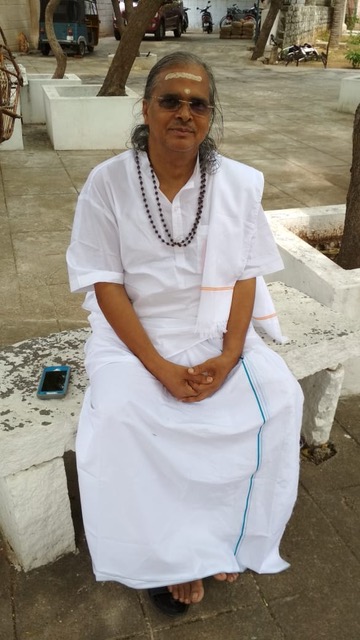
Swamiji’s message recorded on 27 July 2018, at Satyachetana Ashram in Tiruvannamalai, Tamil Nadu, India.
Click below on the triangle “play” icon to hear the audio recording.
10 minutes.

Swamiji’s message recorded on 27 July 2018, at Satyachetana Ashram in Tiruvannamalai, Tamil Nadu, India.
Click below on the triangle “play” icon to hear the audio recording.
10 minutes.

The last verse of the ninth chapter says, “manmanaa bhava madbhakto madyaaji maam namaskuru…” (“…think only of Me, become My devotee, perform sacrifices for Me, have reverence for Me…”)
Out of the four, which one should come first, if someone is sincerely practicing the yoga of Gita? In other words, for one who is seriously doing yoga to reach the goal, which state comes first in the life of such a yogi, and what’s the natural sequence, the natural order?
Every verse, every concept of gita is an expression of the realization process. So which attainment will come first—madyaaji, manmanaa bhava, madbhakto, or maam namaskuru? And which will come second, third and fourth?
Those who send their answers will get my answer to this question.
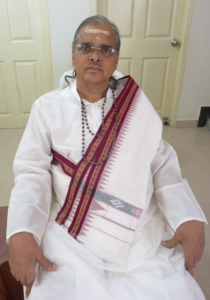
Om Namo Bhagavate Vasudevaya
Today 21st June 2018 is the International Yoga Day, and the third day of my 68th year.
I would like to inquire to all the yogis and seekers of the world who are pursuing yoga to reach the goal. I’m not going to mention anything about the goal. I leave it to each yogi to decide what is the goal for which he is striving.
This is my first question to the seekers in this year. Anyone who will send their answer to me through this website will receive my recorded audio commentary on this verse, if they send the answer by 28th June.
Verse 63
naasato vidyate bhaavo naabhaavo vidyate satah
ubhayor api drishtontas tvanayos tattva-darshibhih
The simple translation is, “Untruth never exists. Truth never ceases to exist. One who has realized both these truths is a true seer.” Many commentators write this differently, that untruth has no beginning and truth has no end. These are different interpretations depending on the understanding level, experiential depth and realizational height of the translator.
What have you realized? I would like to know the seeker’s view, and to help the seeker get the correct meaning through his own experience and from his own realization, and maybe from his understanding, I have these questions.
“Untruth never exists.” If this is true, then why is one perturbed when one sees untruth? Is untruth something to be seen, or is untruth something to be experienced? We are perceiving that untruth is being manifested everywhere by almost everybody, so what is referred to here by untruth? If Gita says untruth never exists, how then can we say that someone is not truthful? If we really recognize the untruth, it means we are saying that Lord Krishna is not correct, and Gita is not correct, because untruth is seen everywhere, but Gita can never be wrong and God can never be wrong.
Question 1: Do you agree with this statement that untruth never exists? If you don’t agree, then there is no need to give an answer. That means, if your view is that untruth exists, you are not agreeing with Gita and Lord Krishna, so why should you waste your time? If you do agree with Gita, give two examples from your own life and two examples from the life in the outer world that you observe.
“Truth never ceases to exist.” That means truth is always present, and if so, why are we not able to see it? Why are we saying that we should manifest truth? It always exists. It should be visible. It should be experienced. Why then is there a struggle to manifest truth? Does it mean truth is everywhere but is not visible? If it is not visible, does it mean not visible to our eyes, not visible to our mind, not visible to our intellect?
Question 2: If you agree with Gita that truth never ceases to exist, give two examples from your own life and two examples from the outer life that show how you agree.
Please contemplate and send the answer to me.
 Powerful, direct guidance for living in daily contemplation. PDF document for download and reading.
$5 payment required. Within 24 hours you will receive a link to download the file.
Please pay here and enter “Sadhana Guidance 1” in the notes field.
 If you are given the assignment to rewrite the Bhagavad Gita in manifestation order, what verse will you put first, as the opening verse?
All those who send a reply will be blessed to receive Swamiji’s explanation of the verse that he would put first. Send replies via the Contact page.
[Excerpts from Swamiji’s Interaction on 2 February 2018, at Veda Yajna Ashram in Bhubaneswar.]
Yogis perform action for atmashuddhi (self-purification). The Self is always pure but during the process of living the coating of contamination comes. That is why the soul is not able to manifest fully, and the contaminations of the material world are manifesting.
Four types of action are performed: through senses, mind, intellect and body. (Verse 215.) Karmas are created through these four gateways. For someone sitting and listening to Swamiji’s interaction, all four types of action are being performed. The listener is in action mode, and although Swamiji is performing vigorous action, he is in inaction mode.
Gita says that even if someone is performing all four types of actions, he is a yogi if he is able to see action in inaction and inaction in action. (Verse 180.)
Karma is a three-dimensional concept: karta (doer), result or consequence, and process. There cannot be any action without a result. Action that is not conscious is not action, it is a process.
Visargah (the process through which the creation is sustained) is karma. What is not visargah is not karma, it is sargah (the creation itself).
God is the only doer, and performs all karma in a state of inaction, whereas humans perform every karma in a state of action. The more we are able to perform action in inaction, the closer we get to God. When you will know that you are not getting contaminated by any karma, you are God, you are a liberated being.
The process is a formidable challenge. First become free from the result. Do the work even if you know there will be no result. Next is doership. We can transcend doership if we are free from praise and censure. Third one is the most difficult, to become free from the process.
The difference between action and inaction: Action always has a result, action always creates a ripple, and action always has a doer. When you will be “I” then you will be in inaction although vigorously performing action. There will be no action, only manifestation of knowledge, love and truth.
Gita contains the cream of all Vedas, Upanishads and all scriptures. Only because of his grounding on Gita is Swamiji able to enter into and decode the Veda.
Jnana (knowledge) is like a sword. To be kept sharp, it must be constantly used.


Swamiji’s farewell to 2017 and welcome to 2018.
Click below on the triangle “play” button to hear the audio recording.
71 minutes.